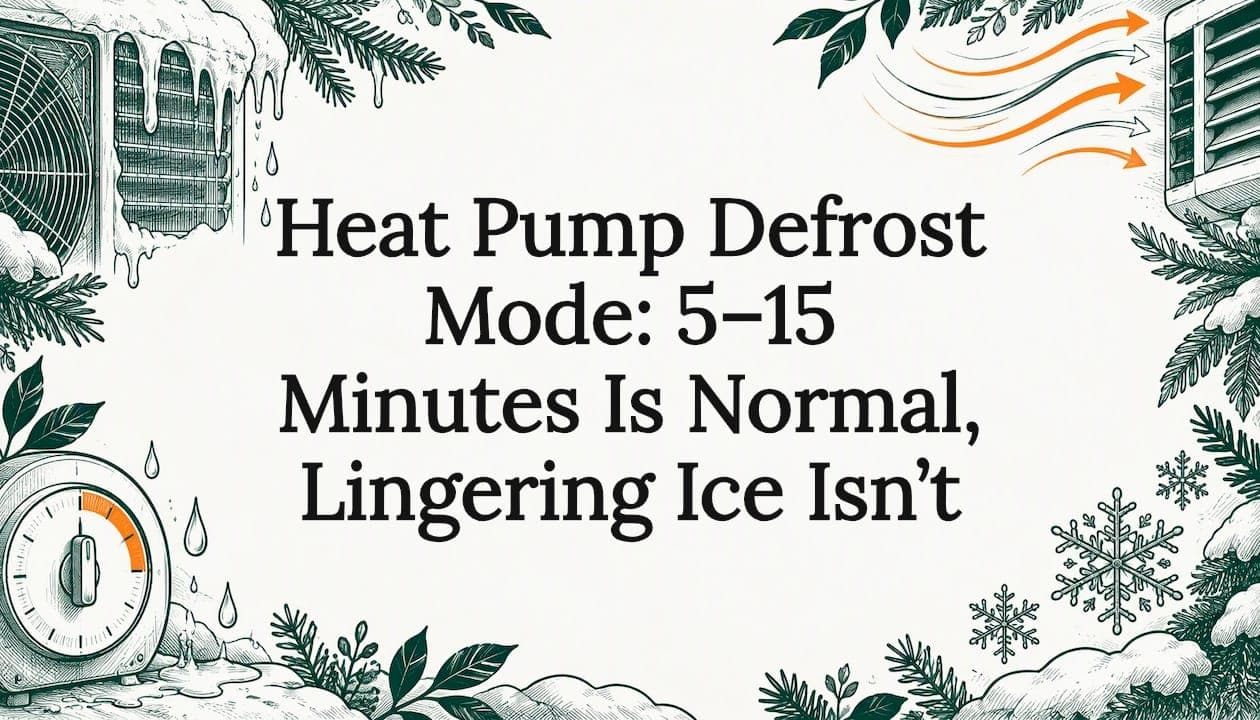
Heat pump defrost mode is an automatic cycle that briefly reverses heat flow to melt ice off the outdoor coil, and it is usually completely normal. A single cycle typically lasts only minutes and happens on and off when conditions favor frost. What deserves attention is a unit that cycles constantly or stays iced over after each one.
TL;DR:
- Demand defrost uses temperature sensors and usually clears frost in 3 to 5 minutes, while fixed schedules may run every 30, 60, or 120 minutes.
- Normal cycles commonly last 5 to 15 minutes and occur 30 to 90 minutes apart in winter; steam, a stopped fan, brief cool air, and meltwater are expected.
- Call a technician if ice remains after defrost, cycles restart immediately, or auxiliary heat runs constantly; airflow, controls, refrigerant, or sizing may be responsible.
- Clear snow and debris, preserve roughly 1 to 3 feet of clearance, and redirect roof runoff, but never chip ice or open refrigerant components.
Table of Contents
- Why does frost form on the outdoor coil?
- How does the defrost cycle work?
- What does normal defrosting look and sound like?
- When does defrosting signal a problem?
- What can you safely check before calling a technician?
- What does the research say about frost and energy use?
- Why sizing and maintenance are your best defense
- How we help when defrost cycles get out of hand
- FAQ
- Sources
Why does frost form on the outdoor coil?
When the outdoor coil drops below 32°F, moisture in the air can freeze onto its surface, which is why condensation can freeze on the coils of a heat pump working in cold weather. Defrost mode exists to clear that ice before it causes trouble.
Here is what frost does and why melting it matters:
- Frost acts like a blanket on the coil, so heat transfers from outdoor air to refrigerant less effectively.
- A thick layer restricts airflow through the fins, forcing the system to work harder for the same output.
- Clearing the ice restores airflow and helps protect the compressor and the system's long-term reliability.
- Frost tends to build most when the air is cold and damp, so a foggy 30°F morning is harder on your unit than a dry, frigid one.
Think of defrost as routine housekeeping. Your heat pump is doing exactly what it was built to do.
How does the defrost cycle work?
Heat pumps use one of two control strategies, and knowing which one you have helps you read what the unit is doing.
- Time-temperature defrost runs on a fixed schedule, such as every 30, 60, or 120 minutes, and may start a cycle even when little frost has formed.
- Demand defrost uses sensors that track coil and outdoor temperatures, so it only starts a cycle when frost is actually detected.
- During any cycle, refrigerant flow reverses to send warmth to the outdoor coil, the outdoor fan generally stops, and auxiliary heat may run to keep the house comfortable.
- The cycle ends when the coil reaches a target temperature or hits a maximum time limit.
Demand defrost is the more efficient design, and its cycles are typically shorter, often lasting 3 to 5 minutes. Fixed-interval systems can waste energy by defrosting a coil that is already clear. Mini split systems follow the same logic, though the exact behavior varies by model, so your manual is the final word on your particular unit.
Demand defrost cycles typically last 3 to 5 minutes, shorter than fixed-interval cycles, which is one reason sensor-based control is easier on your energy bill.
What does normal defrosting look and sound like?
Normal defrosting is brief, a little dramatic to watch, and then over. A single cycle commonly runs 5 to 15 minutes, and in winter the cycles tend to be 30 to 90 minutes apart, depending on humidity and outdoor temperature. There is no universal correct number of cycles per hour, because frequency depends on weather and product design.
Here is what you are likely to notice:
- Steam or vapor rising from the outdoor unit as the ice melts.
- The outdoor fan stopping for a few minutes, then starting again.
- Auxiliary or emergency heat switching on briefly to hold indoor temperature.
- A short, mild dip in indoor warmth, sometimes with slightly cool air from the vents.
- Dripping or running meltwater beneath the unit.
If your system does these things now and then, and the coil looks clear afterward, that is normal operation and not an emergency. Our guide on why a heat pump can blow cool air for a few minutes in cold climates covers the indoor side of this in more detail.
When does defrosting signal a problem?
Defrosting becomes a concern when it stops doing its job or never seems to stop. Watch for these red flags:
- Ice is still on the coil after a defrost cycle finishes.
- The unit is consistently covered in ice, not just lightly frosted.
- It spends most of its time in defrost, or cycles back in almost immediately.
- The house is noticeably colder and auxiliary heat keeps running.
Several causes can sit behind those symptoms:
- Restricted airflow from snow, debris, or poor placement.
- A faulty sensor or defrost control board that triggers cycles wrongly or fails to end them.
- Low refrigerant, which can leave the coil too cold to recover.
- Improper sizing or commissioning, so the system is chronically overworked in cold weather.
Placement matters more than most owners expect. Poor placement or close spacing can prevent effective defrosting, and about 1 to 3 feet of clearance is typical guidance for preserving airflow. Runoff is another culprit: roof water that drips onto a unit gives it more ice than any cycle can clear, a point the team at Highlander explains well in their piece on mountain roof ventilation.
Repeated, ineffective cycles also cost you money, because the system spends energy melting ice instead of heating your home.
Pro Tip: Take a photo of the outdoor unit right after a defrost cycle ends. If the same ice pattern shows up in every photo, a technician can diagnose the cause much faster.

What can you safely check before calling a technician?
Start with the simple, safe steps below, and stop the moment anything involves opening sealed components.
- Clear snow, ice, and debris from around the outdoor unit, keeping your hands and tools off the fins.
- Confirm the unit has its recommended clearance on all sides and that nothing, such as a drift or a shrub, is blocking airflow.
- Direct meltwater away from walkways and steps so it cannot refreeze into a slip hazard.
- If your model supports a fan-only or manual defrost option and your manual permits it, try it, then monitor whether the system improves.
- Never pry at ice with a tool, and never open refrigerant components or panels.
Our walkthrough of safe DIY checks to thaw a frozen coil goes deeper on the indoor side, and we explain when to clean a coil yourself and when to call a pro separately.
Call a professional if ice persists after cycles, if you suspect a refrigerant leak, if a thermostat or control fault seems likely, or if auxiliary heat keeps running.
Pro Tip: Note the outdoor temperature and the time between cycles when you call. Those two details help a technician tell a sensor problem from a sizing problem.
What does the research say about frost and energy use?
The efficiency cost of frost is measurable, and it explains why controls and design matter.
- Research on cold-climate systems found that frosting and defrost cycles raised energy consumption by roughly 12 to 12.5% in the cases studied.
- Demand-defrost controls run fewer and shorter cycles than fixed-interval schedules, which helps seasonal efficiency.
- Reducing frost growth through design or surface coatings is an active research area, because less frost means fewer defrost cycles and less wasted energy.
Frosting and defrost cycles increased energy use by roughly 12 to 12.5% in cold-climate cases, so a unit that defrosts constantly is quietly raising your heating costs.
Why sizing and maintenance are your best defense
We focus on sizing systems to the home's real heat loss and keeping coils clean. Getting sizing and commissioning right at installation keeps a unit from working at its limit every cold morning, and our notes on sizing and commissioning inverter heat pumps for cold climates explain what that looks like in practice. After that, keep airflow clear and the coil clean. When ice problems persist, we would rather you book a proper diagnostic of the sensors, refrigerant, and airflow than gamble on a DIY fix that could damage the system.
— John
How we help when defrost cycles get out of hand
If ice remains after defrost, auxiliary heat runs constantly, or you suspect a placement or commissioning problem, we can help. We offer one-time deep cleaning, installation, change-outs, and preventive maintenance and troubleshooting, and our deep cleaning starts at 249 USD one-off. For ongoing protection, our Annual Cleaning Plan is 219 USD per year and the Maine Heat Pump Care Plan is 319 USD per year. We also check commissioning and system sizing as part of our installation planning.
Schedule a diagnostic or enroll in a care plan today, and we will confirm service for your ZIP code before any appointment or payment.
FAQ
How often should a heat pump go into defrost mode?
There is no single correct number, because frequency depends on humidity, outdoor temperature, and how the unit is designed. In winter, cycles commonly occur 30 to 90 minutes apart. More frequent cycles that fail to clear the ice deserve a technician's look.
At what temperature does a heat pump go into defrost mode?
Frost becomes likely once the outdoor coil falls below freezing and the air carries moisture. Condensation can freeze on coils below 32°F. The exact trigger depends on whether your unit uses timed or sensor-based control.
Why would a heat pump go into defrost mode?
It defrosts to melt frost that has built up on the outdoor coil, restoring airflow and heat transfer. Skipping it would let ice choke the coil and strain the system. Cycles that happen often without clearing the ice can point to blocked airflow, a bad sensor, low refrigerant, or sizing issues.
Can you force a heat pump into defrost mode?
Some models offer a manual or fan-only defrost option, but this varies, so check your manual before trying it. If your manual does not describe one, leave it to a technician. Never chip at ice or open sealed refrigerant parts yourself.
Sources
- Hvac
- YOU INSTALLED AN AIR SOURCE HEAT PUMP.
- Source Heat Pump for Cold Climates considering the effects of Frosting
- Ashrae