
An inverter heat pump uses a variable-speed compressor to deliver more consistent comfort and higher part-load efficiency than fixed-speed models. Instead of switching fully on and off, it ramps output up and down to match the heating or cooling load, which cuts wasted energy and reduces temperature swings. Cold-climate versions can heat homes effectively at very low outdoor temperatures, but only when sized correctly and installed by someone who commissions the system properly.
TL;DR:
- Proper sizing based on a detailed heat-loss calculation and correct commissioning are critical for inverter heat pump performance in cold climates.
- Field studies show that low indoor airflow and improper thermostat pairing are common causes of underperformance, rather than equipment faults.
- Cold-climate ratings based on ENERGY STAR criteria ensure units meet specific capacity retention and efficiency standards at 5°F.
- Cost-effective installation varies: ductless systems generally cost less upfront but may require careful zone planning; larger, ducted systems are more expensive but serve multiple zones easily.
- Regular maintenance focused on airflow, refrigerant charge, and outdoor placement maximizes inverter heat pump efficiency and longevity.
Table of Contents
- How inverter (variable-speed) heat pumps work
- Advantages over conventional heat pumps
- Cold-climate performance and the standards worth checking
- Choosing and sizing your system the right way
- Costs, rebates, and what to expect on your energy bill
- Maintenance and the field problems that quietly cut performance
- Troubleshooting error codes and inverter problems
- Brands, models, and what warranty coverage typically looks like
- Environmental impact and the energy savings case
- What good cold-climate installation practice actually looks like
- Sizing, installation, and care plans from HITA
- Sources
- FAQ
How inverter (variable-speed) heat pumps work
A standard single-speed heat pump has two settings: on and off. It runs at full power until the thermostat is satisfied, then shuts down completely, which causes temperature swings and wastes energy every time the compressor restarts.
An inverter-driven compressor changes speed continuously, adjusting output to match the exact heating or cooling demand at any given moment. That steady, lower-speed operation also keeps the coil colder for longer during cooling season, which pulls more moisture out of the air.
The practical differences break down like this:
- Single-speed units run at one output level and cycle on and off, which is the least efficient at partial loads.
- Two-stage units offer a low and a high setting, an improvement over single-speed but still a stepped response rather than a smooth one.
- Inverter variable-speed units adjust output across a wide range, matching load closely and avoiding the energy penalty of frequent starts and stops.
Advantages over conventional heat pumps
The efficiency gap between inverter and fixed-speed systems shows up most clearly at partial load, which is where a heat pump spends most of its operating hours in a typical home.
- Efficiency: Variable-speed compressors typically carry higher SEER2 and HSPF2 ratings than single-speed equivalents, because they avoid the losses tied to constant cycling.
- Comfort: Continuous modulation means smaller temperature swings around the thermostat setpoint, rather than the overshoot and drift common with on/off systems.
- Noise and cycling: Running at lower speeds most of the time also means quieter operation and far less short-cycling, which extends component life.
Variable-speed compressors are widely described as the standard for comfort and humidity control in consumer buying guides, largely because slower, longer runtimes dehumidify better than short blasts of full-speed air. Even a well-matched inverter system will occasionally need help. In extreme cold, some installations pair the heat pump with auxiliary or backup heat, especially in older homes with higher heat loss, though many cold-climate models are designed to minimize or eliminate that need.
Cold-climate performance and the standards worth checking
Not every heat pump marketed as "cold climate" performs the same way at low temperatures, so it helps to know what the label is supposed to guarantee. The ENERGY STAR cold-climate criteria set specific thresholds manufacturers must meet to use that designation, including a coefficient of performance (COP) of at least 1.75 and capacity retention of at least 70% when tested at 5°F.
- COP at low temperature tells you how much heat the unit delivers per unit of electricity consumed when it is genuinely cold outside, not just at moderate test conditions.
- Capacity retention at 5°F shows how much of the unit's rated heating output survives in real winter weather, which matters more than the nameplate capacity at 47°F.
- SEER2 and HSPF2 reflect updated testing procedures with more realistic external static pressure, so they are not directly comparable to older SEER and HSPF numbers on a previous system.
Field monitoring has found that inverter-driven systems can perform well in cold climates, but real-world efficiency varies widely depending on installation quality and site-specific factors, according to NREL and DOE field validation research. A unit that tests well in a lab can still underperform in a house if it is not sized or commissioned correctly.
Choosing and sizing your system the right way
Sizing is where most inverter heat pump installations succeed or fail, and it starts long before any equipment gets mounted.
- Ask for a formal heat-loss calculation, not a rule-of-thumb estimate based on square footage alone; a proper calculation accounts for insulation, windows, air sealing, and local design temperatures, similar to the heat-load methodology outlined by industry sizing standards.
- Confirm the installer will commission the system, which means verifying airflow, checking refrigerant charge, and pairing the unit with the communicating thermostat the manufacturer specifies rather than a generic model.
- Review outdoor unit placement, since snow drift, wind exposure, and clearance around the unit all affect winter performance.
- Check ductwork condition on ducted systems, because leaky or undersized ducts can erase much of the efficiency gain from a variable-speed compressor.
- Plan multi-zone layouts carefully if you are covering more than one area, matching indoor head capacity to each zone's actual heat loss rather than splitting total capacity evenly.
Red flags include a contractor who skips the heat-loss calculation, quotes a single "one size fits most homes" system, or plans to install a non-communicating thermostat with equipment designed for one.
Pro Tip: Ask to see the heat-loss report and the equipment's cold-climate performance data side by side before you sign a quote.
Costs, rebates, and what to expect on your energy bill
Installed costs vary by system type, and getting a rough sense of the range helps you evaluate quotes without being blindsided.
- Ductless mini-split systems tend to cost less upfront than fully ducted central systems, particularly for single or dual-zone installations.
- Ducted systems cost more due to ductwork and equipment size, but they can serve a whole home from one air handler.
- Cost drivers include total capacity needed, the number of indoor heads or zones, any electrical panel upgrades required, and labor for commissioning.
- Rebates and incentives are often tied to ENERGY STAR or Cold Climate listings, so confirming a unit's certification status before purchase can affect what you qualify for.
A simple way to estimate operating savings is comparing your current fuel cost per unit of heat delivered (electric resistance, oil, or propane) against the heat pump's expected output at your climate's average winter temperature, since the gap tends to be largest when replacing oil or propane systems, according to general guidance in heat pump buying resources.
Maintenance and the field problems that quietly cut performance
Routine maintenance is mostly simple: homeowners can clean or replace filters regularly and keep the outdoor unit clear of snow, leaves, and debris. Anything involving refrigerant charge, electrical components, or airflow diagnostics needs a professional.
Building America and CARB field monitoring found monthly COPs ranging widely, from 1.1 to 3.1, and traced much of that variation to low indoor airflow and improper fan settings rather than equipment defects, according to Building America field performance data.
- Low airflow often comes from dirty filters, undersized ductwork, or fan speed settings that were never adjusted after installation.
- Poor outdoor unit placement can restrict airflow or expose coils to excess snow and ice.
- Thermostat mismatch with a non-communicating model can prevent the system from modulating properly, even if the equipment itself is capable.
Pro Tip: If your system seems to run constantly without keeping up on a cold day, ask for an airflow and refrigerant charge check before assuming the equipment is undersized.
Troubleshooting error codes and inverter problems
When an inverter heat pump displays an error code or stops modulating properly, the cause is usually one of a handful of common issues rather than a mystery fault.
Communication errors between the indoor and outdoor units are among the most frequent problems, often triggered by loose wiring connections, a firmware mismatch after a component swap, or interference on the control line. These typically show up as a specific code on the indoor unit's display or the thermostat.
Inverter board faults, sometimes flagged as a drive or compressor error, can result from voltage irregularities, a failing sensor, or the compressor struggling against restricted airflow rather than an inverter board defect itself. A unit that short-cycles, fails to reach setpoint, or runs continuously at full speed without modulating often has an airflow restriction, a low refrigerant charge, or a thermostat that isn't communicating correctly with the system, rather than a true inverter failure.

Frost or ice buildup that doesn't clear during a defrost cycle points to a defrost sensor issue or a control board problem, not necessarily a compressor fault. Before assuming a major component has failed, it is worth checking simple things: a tripped breaker, a dirty filter restricting airflow, or a thermostat setting that was changed accidentally. Because inverter systems rely on tightly coordinated communication between the outdoor unit, indoor unit, and thermostat, a technician with experience in variable-speed diagnostics is often faster at isolating the actual fault than someone used to single-speed systems.
Brands, models, and what warranty coverage typically looks like
The inverter heat pump market includes a wide range of manufacturers, from established HVAC brands to companies that specialize specifically in cold-climate equipment. Reliability varies by model line within a brand as much as it does between brands, since a manufacturer's cold-climate flagship unit and its entry-level ducted system are built to different standards.
Warranty terms typically separate parts coverage from compressor coverage, with compressor warranties often running longer than the coverage on other components. Registration requirements matter too: many manufacturers require the homeowner or installer to register the equipment within a set window after installation to activate full warranty terms, and skipping that step can shorten coverage significantly.
Because warranty claims often depend on proof of proper installation and maintenance, keeping records of commissioning reports, filter changes, and any service visits protects you if a component fails within the coverage period. When comparing models, the equipment's cold-climate certification status and its documented capacity retention at low temperatures matter more for long-term satisfaction than brand name alone.
Environmental impact and the energy savings case
Inverter heat pumps reduce energy consumption compared to fixed-speed equipment because they avoid the losses associated with full-power cycling, and that efficiency gain compounds over a heating season. Replacing a fossil-fuel furnace or boiler with an efficient heat pump also shifts heating demand onto the electric grid, which matters for carbon footprint depending on how that electricity is generated.

The efficiency advantage is largest when replacing electric resistance heating, oil, or propane systems, since a heat pump moves existing heat rather than generating it from combustion or resistance elements. Field validation research has found that inverter-driven, variable-capacity systems can operate effectively in cold climates, according to DOE and NREL monitoring, which supports their use as a lower-carbon alternative to combustion heating in many climates.
Actual carbon savings depend heavily on the local electricity mix and how efficiently the specific system is installed and operated, so a well-sized, properly commissioned inverter heat pump captures more of that potential than one installed with the airflow and sizing problems documented in cold-climate field studies.
What good cold-climate installation practice actually looks like
Cold-climate performance is decided at the design stage, not after installation. A heat pump sized from a real heat-loss calculation, matched to cold-climate-rated equipment, and commissioned with the correct thermostat behaves nothing like one installed on guesswork. Homeowners deserve a site visit, a written heat-loss report, and a quote that explains why a specific unit was chosen for their home.
— John
Sizing, installation, and care plans from HITA
If you want the approach described above without chasing down a heat-loss calculation yourself, some installers build every quote around one, sized specifically for your home's real heat loss and local winter conditions rather than a generic estimate.
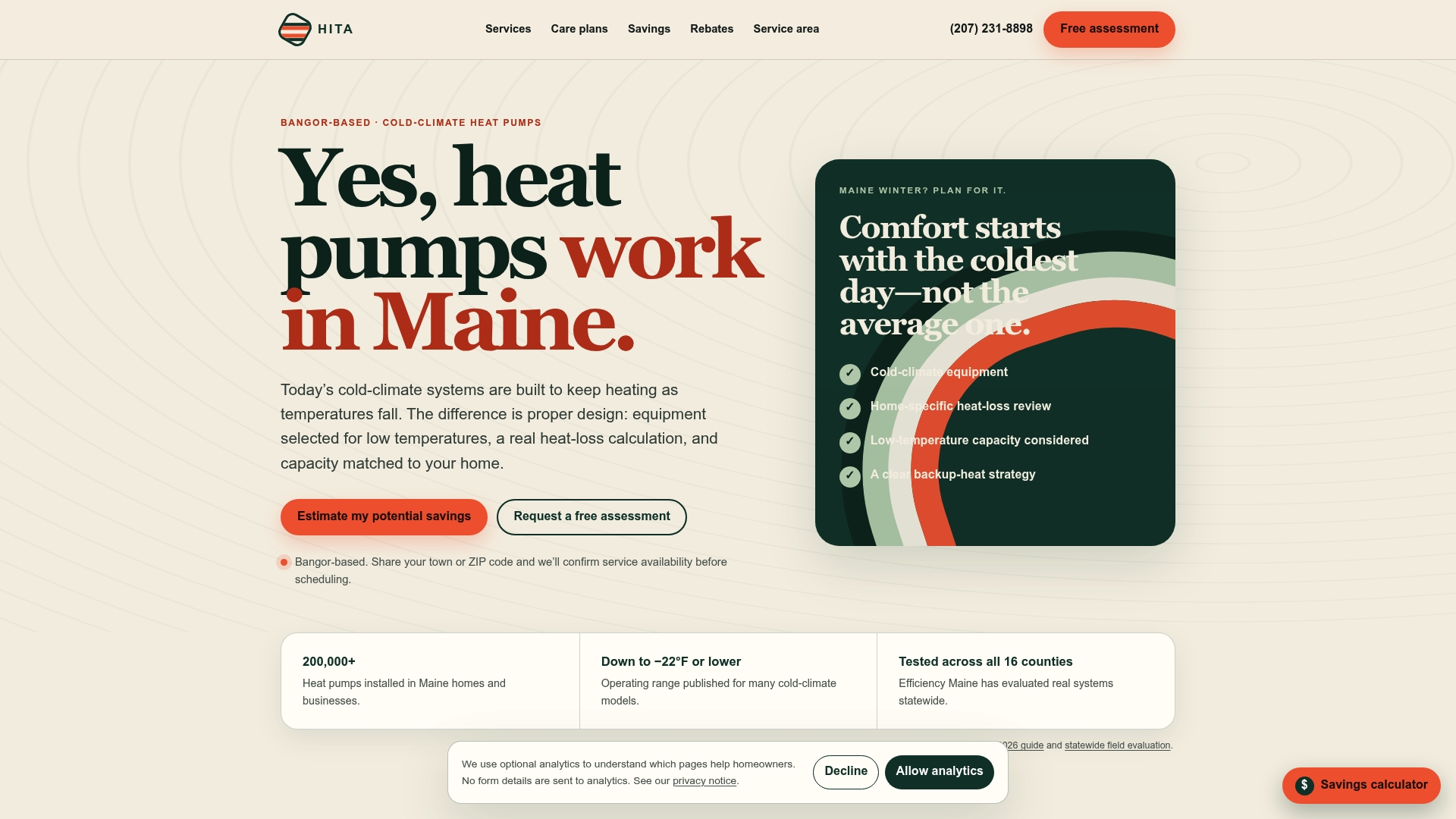
- New heat pump installation and existing heat pump change-outs, both based on custom sizing rather than rule-of-thumb capacity.
- Preventive maintenance and troubleshooting to catch airflow and refrigerant issues before they cut into efficiency.
- Annual Cleaning Plan at $219 per year and the Maine Heat Pump Care Plan at $319 per year, both detailed on the plans page.
- Rebate guidance during the planning process, since certification status affects what you can claim.
Request a site assessment through the installation planning page and have your current heating fuel type and approximate square footage ready. Service is confirmed by ZIP code before scheduling, so availability depends on your specific location in Maine.
Sources
- Field Validation of Air-Source Heat Pumps for Cold Climates (Winkler & Ramaraj, 2023)
- Field performance of inverter-driven heat pumps in cold climates (Building America / CARB)
- Heat pump buying guide | Consumer Reports
FAQ
What is an inverter heat pump?
An inverter heat pump is a system with a variable-speed compressor that adjusts its output to match heating or cooling demand, rather than cycling fully on and off. This modulation improves part-load efficiency, reduces temperature swings, and typically results in quieter operation than single-speed equipment.
Is an inverter heat pump better than a regular heat pump?
Inverter models generally offer better comfort and higher part-load efficiency than single-speed or two-stage heat pumps, since they avoid the energy losses tied to frequent cycling. The advantage depends on correct sizing and installation, since field monitoring has found that real-world performance varies with airflow, placement, and commissioning quality, per field validation research from DOE and NREL.
How do I know if a heat pump is rated for cold climates?
Look for the ENERGY STAR Cold Climate designation, which requires a unit to meet specific COP and capacity retention thresholds when tested at 5°F, detailed in ENERGY STAR's key product criteria. A unit without this designation may still work in moderate cold, but its low-temperature performance is not independently verified against these criteria.
What causes an inverter heat pump to underperform after installation?
The most common causes documented in field studies are low indoor airflow, improper fan settings, and thermostat mismatches that prevent the system from modulating correctly. Building America and CARB monitoring found these installation-related issues, not equipment defects, explain much of the performance variation seen in the field.
Does HITA install inverter heat pumps designed for cold climates?
HITA specializes in installing and maintaining cold-climate heat pumps sized through custom heat-loss calculations for Maine's winter conditions. Services include new installations, change-outs, and ongoing care plans, with pricing for maintenance plans listed on its plans page.