Short cycling is when a heat pump turns on and off far more often than it should, running for a few minutes at a time instead of holding a steady cycle. It stresses the compressor, spikes your electric bill, and often leaves rooms colder or damper than they should be. If it just started, record the run and off times for a few hours; if it has gone on for more than a day or you smell anything electrical, call a technician now.
TL;DR:
- Short cycling occurs mainly due to improper system sizing, such as oversizing or zoning mismatches, and can be identified by frequent compressor starts and indoor temperature inconsistencies.
- Restricted airflow from clogged filters or debris is a common cause that can often be addressed through simple maintenance, while refrigerant leaks or mechanical faults require professional repair.
- To prevent repeated service calls, homeowners should insist on documented load calculations and commissioning reports before installation, and regularly maintain filters and outdoor coil clearance.
- Safe checks like cleaning filters, verifying thermostat settings, and noting cycle timing can help homeowners troubleshoot before calling a technician, but refrigerant and electrical issues need expert diagnosis.
- Proper system sizing and installation, including correct airflow and refrigerant levels, are key to avoiding short cycling and achieving reliable, energy-efficient operation.
Table of Contents
- What Does Heat Pump Short Cycling Look Like?
- What Causes a Heat Pump to Short Cycle?
- What Can Homeowners Safely Check Before Calling for Service?
- When Should You Call a Professional?
- How Do You Fix and Prevent Short Cycling?
- What HITA Sees in the Field
- Why Commissioning Beats Repeated Repairs
- How Hitamaine Fixes and Prevents Short Cycling
- Sources
- FAQ
What Does Heat Pump Short Cycling Look Like?
You'll usually notice the pattern before you understand it. A heat pump that's short cycling runs for only a few minutes at a time, then shuts off, sits idle briefly, then fires back up repeatedly instead of running steady cycles long enough to complete heating or cooling calls.
Watch for these specific signs:
- Frequent starts: more than 3 to 4 compressor starts per hour when outdoor temperatures haven't changed much.
- Rooms that never feel right: warm spots mixed with cold ones, or humidity that stays high in cooling mode because the system never runs long enough to actually dehumidify the air.
- A tripped breaker or a system that won't restart for several minutes after shutting off.
- Visible ice on the outdoor coil or refrigerant lines, especially outside of a normal defrost cycle.
- Error codes on the thermostat or outdoor unit display, even if the system otherwise seems to be running.
- A knocking, humming, or buzzing sound right as the compressor kicks on, which can point to electrical strain from repeated restarts.
One catch worth knowing: mini splits and other inverter-driven systems are designed to modulate compressor speed instead of shutting completely off, a behavior Bryant describes as "cruise" mode. Slowing down isn't short cycling. The problem is a full stop-start-stop pattern, not a system quietly throttling down on a mild afternoon. Before calling a contractor, jot down the exact run and off times for at least three or four cycles. That log is the single most useful thing you can hand a technician.
What Causes a Heat Pump to Short Cycle?
Short cycling almost always traces back to one of five categories, and the order you check them in matters. Field data from the Department of Energy's cold-climate heat pump validation study makes a point worth repeating: you can't diagnose cycling behavior from outdoor temperature alone. Two identical houses on the same cold night can show completely different run patterns depending on thermostat schedules, internal heat gains, and how the controls are set up.
- Oversized equipment or poor zone matching. A heat pump sized for the whole house but paired with a small bedroom zone will satisfy that zone's thermostat in minutes, then shut off, then restart as the room drifts a degree. This is the single most common cause in new installations, and it's a sizing problem, not a mechanical one.
- Thermostat and sensor issues. A thermostat mounted near a supply vent, a sunny window, or a drafty doorway reads the air around it, not the room. It cycles the system on and off chasing a temperature that isn't representative of the space.
- Restricted airflow. A clogged filter, a blocked return grille, a crushed duct run, or a dirty indoor coil all choke the air the system needs to move. Reduced airflow trips high or low pressure safety switches, which shuts the compressor down early and often.
- Refrigerant and mechanical faults. A slow leak, an undercharged system, or a compressor that's starting to fail will often show gradual cycling that gets worse over weeks, not overnight. This is where DIY checking stops and a licensed technician's gauges start.
- Electrical, control, and outdoor unit problems. A failing contactor, a control board throwing false signals, or an outdoor unit crammed too close to a fence or wall (restricting airflow across the coil) can all trigger premature shutdowns. Defrost cycling that runs too often, or auxiliary heat that kicks on and off erratically, can also look like short cycling when it's really a control logic issue.
Timing tells you a lot before a technician even shows up. If short cycling started the moment the system was installed or a new zone was added, look at sizing and commissioning first. If it developed gradually over weeks or months, suspect a refrigerant leak, a failing part, or a coil that's slowly clogging with debris. That distinction alone can save a service call from turning into a guessing game.
What Can Homeowners Safely Check Before Calling for Service?
A handful of checks are safe, useful, and take less than 20 minutes. They also happen to catch some of the most common causes on their own.
- Replace or clean the return air filter if it's visibly dirty or hasn't been changed in the last one to three months.
- Walk around the outdoor unit and clear leaves, snow, mulch, or anything within 12 to 18 inches of the coil.
- Confirm the thermostat is set to the correct mode (heat, not auto or cool) and the setpoint makes sense for the season.
- Look for visible ice on the outdoor coil or lines outside of a normal defrost cycle, and note any error code on the display.
- Time three or four full cycles with a phone timer and write down the outdoor temperature at the same time.
Pro Tip: Build a simple log before you call anyone: date, outdoor temperature, thermostat mode and setpoint, run time, off time, starts per hour, any error code, filter condition, and which zone is acting up. A technician who receives that log on arrival can often skip an hour of guesswork.
What you should never do is open a refrigerant line, bypass a safety switch or float switch, poke at live electrical connections, or keep resetting a tripped breaker hoping it holds. Repeated breaker resets on a system that's actually drawing too much current can damage a compressor that might otherwise have been repairable.
When Should You Call a Professional?
Call a technician if short cycling continues after your safe checks, if a breaker trips more than once, if you smell anything electrical or burnt, or if the compressor starts cycling immediately after a new installation or zone addition. That last one is important: brand-new short cycling almost always points to a sizing or commissioning mistake, not wear and tear, and it's worth flagging to the installer before the warranty clock runs out on a callback.
A competent diagnostic visit should work through this list, in roughly this order:
- Airflow test across the indoor coil and duct system, checking static pressure against manufacturer specs.
- Refrigerant charge verification and a leak search using an electronic detector, not just a pressure gauge glance.
- Thermostat and sensor calibration, including where it's mounted and how it's wired into the system.
- Control board fault history pulled from the unit's memory, not just a visual inspection.
- Minimum capacity and turn-down ratio checked against the home's actual heat-loss numbers, not just the nameplate rating.
- Defrost cycle timing and auxiliary heat behavior observed during an active cycle, since defrost sequencing can create cycling patterns that look mechanical but are really a control setting.
- Outdoor unit clearance and mounting stability check, confirming nothing is restricting coil airflow.
Ask the contractor for paperwork, not just verbal reassurance. That means:
- A copy of the original ACCA Manual J load calculation and Manual S equipment selection, if one exists.
- Manufacturer minimum-capacity or turn-down data for the specific model installed.
- A written commissioning report showing measured airflow, charge, and run-time testing.
- Any prior repair records if this isn't the first service call.
If a contractor can't produce a Manual J or explain the equipment's minimum turn-down ratio, that's a red flag worth pushing back on before you approve any repair.
How Do You Fix and Prevent Short Cycling?
Fixes fall into three tiers, and knowing which tier you're in changes what a repair should cost and how long it should last. Quick fixes solve simple problems fast: swapping a filter, clearing outdoor clearance, relocating a poorly placed thermostat, or adjusting a control setting. These take an hour and often solve the issue completely if the root cause really was that simple.
Certified repairs cover anything involving refrigerant, electrical components, or major parts: recharging or repairing a leak, replacing a failing blower motor or compressor, or deep-cleaning a clogged indoor coil. These require EPA-certified technicians and typically come with a real diagnostic bill, but they address mechanical failure directly rather than papering over it.
Design and installation remedies are the ones that actually prevent short cycling from coming back. ACCA Manual J load calculations exist precisely because guessing at equipment size is the single biggest driver of chronic cycling. Sizing guidance also stresses that a system's minimum capacity, not just its maximum, determines whether it can hold a steady low-load cycle instead of slamming on and off in mild weather. For multi-zone systems, the fix for a mismatched small zone usually isn't a bigger indoor unit. It's reconfiguring zones or adding a second, smaller outdoor unit so each zone's load actually matches what the equipment can modulate down to.
Prevention comes down to a handful of habits:
- Get a documented load calculation before any installation or major replacement, not a rule-of-thumb estimate.
- Request a written commissioning report at the end of installation, confirming measured airflow, charge, and minimum run times.
- Change filters on a set schedule and keep the outdoor unit's coil clear year round.
- Enroll in a maintenance plan that includes coil cleaning and a seasonal performance check rather than waiting for a failure to call.
Pro Tip: If a system has been "fixed" for the same short cycling complaint more than twice, stop treating it as a repair problem. At that point, a fresh Manual J and a sizing review usually cost less over two years than another round of service calls.
Replacement makes sense when the unit is grossly oversized for the home, when the compressor itself has failed, or when the equipment simply lacks the turn-down ratio to run efficiently at your home's actual load. Repeated symptom suppression on a fundamentally mismatched system just delays the real fix and keeps the electric bill higher than it needs to be in the meantime.
What HITA Sees in the Field
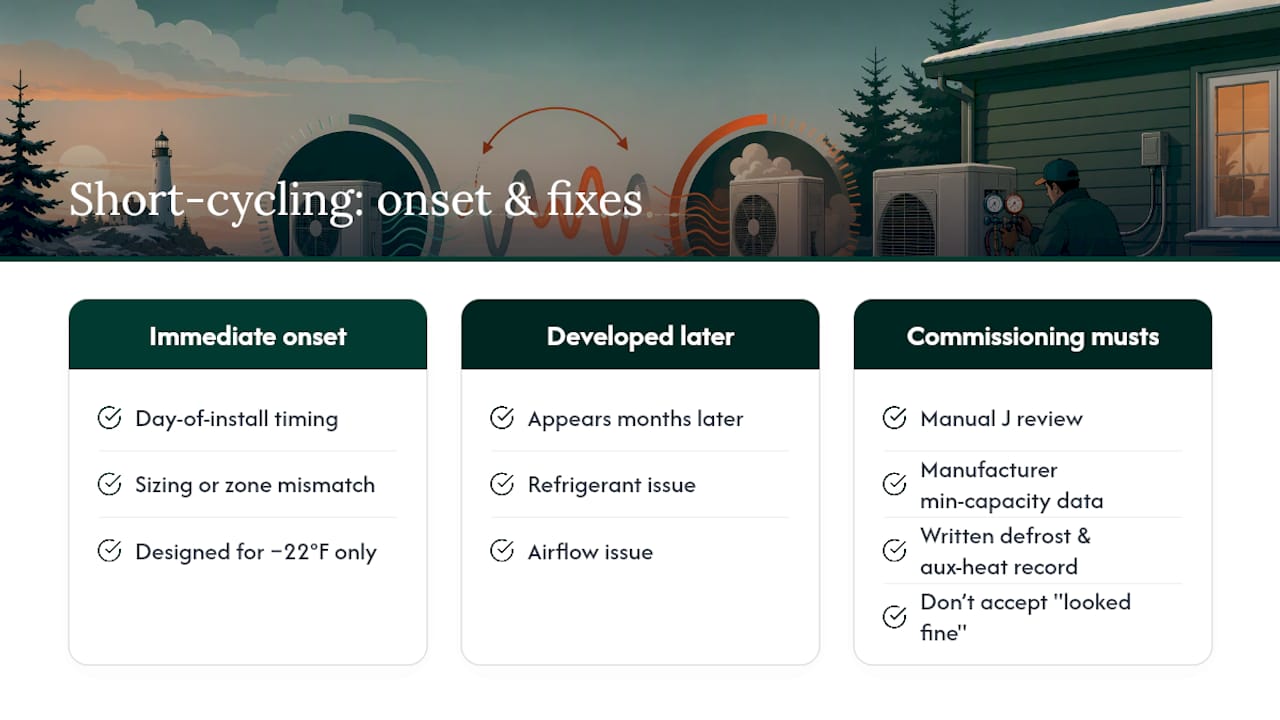
Cold-climate systems in Maine face a specific version of this problem: equipment has to handle both a deep winter design load and long stretches of mild shoulder-season weather without cycling apart at either extreme. Hitamaine has installed over 200,000 heat pumps statewide, and the pattern that shows up again and again is equipment sized for a design day of −22°F that then short cycles constantly every October and April, because nobody checked its minimum turn-down ratio against a 45°F afternoon.
Onset timing still drives the diagnosis. Short cycling that starts the day of installation almost always traces back to sizing or a zone mismatch. Cycling that develops months later usually means a refrigerant or airflow issue. Any commissioning visit worth paying for should include a Manual J review, manufacturer minimum-capacity data, and a written record of observed defrost and auxiliary heat behavior, not just a technician's word that "it looked fine."
Why Commissioning Beats Repeated Repairs
I've read through enough field data to notice a pattern: homeowners keep paying for the same short cycling complaint two or three times before anyone opens a load calculation. Documented sizing work isn't a paperwork formality. It's the difference between a fix that lasts and a service call you'll be scheduling again next season. If you're buying or replacing a heat pump, insist on seeing a Manual J and a commissioning report before you sign anything.
— John
How Hitamaine Fixes and Prevents Short Cycling
Most short cycling complaints trace back to a sizing mistake nobody caught at installation, and no amount of filter changes fixes a heat pump that was never matched to your home's actual heat loss in the first place. Some installers build installations around real heat-loss calculations instead of nameplate guesses, which can help prevent chronic cycling rather than quieting it temporarily.
A diagnostic visit starts with a review of your system's documentation, including any existing load calculation and prior repair history, followed by field verification of airflow, refrigerant charge, and minimum run-time behavior. You'll get written recommendations, not just a verbal patch job. If replacement makes more sense than repair, Hitamaine's installation planning process walks through custom sizing before any equipment gets ordered, and the team can also help you sort out available rebates for the new system. If your current unit just needs a proper checkup, book a service visit and get a firsthand look at what's actually driving the cycling.
Sources
Bring these to any commissioning conversation: the DOE sizing guide for load calculations, the DOE field validation study for real-world cycling data, the ENERGY STAR homeowner guide for installation basics, and Trane's short cycling glossary for plain-language definitions.
- Guide To Sizing & Selecting Air-Source Heat Pumps in Cold Climates
- Field validation of air-source heat pumps for cold climates
FAQ
What Causes a Heat Pump to Short Cycle?
Oversized equipment, poor thermostat placement, restricted airflow, and refrigerant leaks are the most common causes. Trane's glossary also flags improper sizing and airflow issues as leading culprits, and onset timing (immediate versus gradual) helps narrow down which one applies.
Is Short Cycling Bad for a Heat Pump?
Yes. Frequent starts stress the compressor, spike energy use, and reduce dehumidification because the system never runs long enough to complete a full cycle. ENERGY STAR's guidance links oversized, poorly matched equipment directly to comfort and efficiency losses.
How Do You Stop a Heat Pump From Short Cycling?
Start with safe checks: filter, outdoor clearance, and thermostat setpoint. If the pattern continues, the durable fix usually involves a load calculation, a control adjustment, or in some cases replacing equipment that lacks adequate minimum turn-down for your home, something Hitamaine builds into every installation and service visit.
How Often Should a Heat Pump Cycle On and Off?
A properly sized system typically runs for longer cycles rather than shutting off frequently. Multiple starts per hour at stable outdoor temperatures usually indicate a need for inspection.
Is Cycling Normal on a Mini Split?
Mini splits and other inverter-driven systems modulate compressor speed instead of stopping completely, a behavior manufacturers describe as cruise mode. A full stop-start-stop pattern several times an hour is not normal, even on an inverter system.