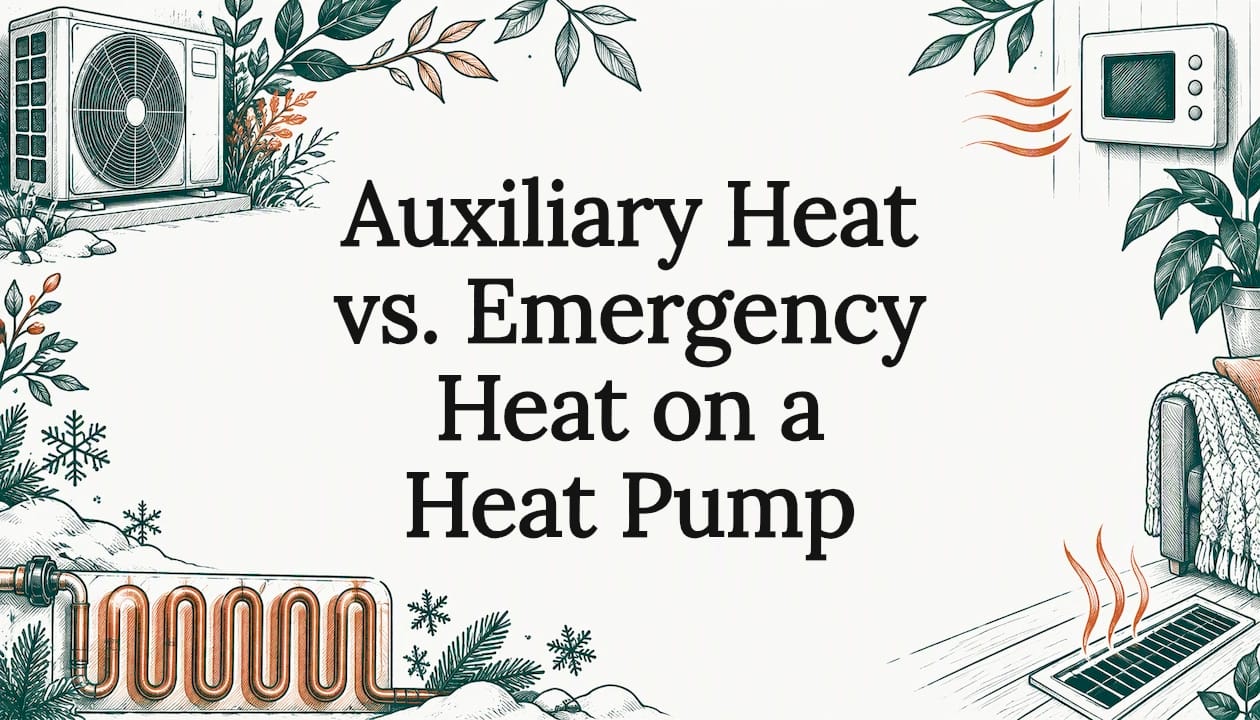
Auxiliary heat ("Aux") is backup heat that your system turns on automatically when the heat pump alone can't keep up. Emergency heat ("EM" or "Emer") is a setting you switch on by hand, and it makes the heat pump sit out while backup heat does all the work. Emergency heat is manual, while auxiliary heat can be used automatically as needed. In short: Aux is normal, occasional and automatic. EM is for a real breakdown.
That difference matters more in Maine than almost anywhere. Long cold stretches mean your backup heat gets tested, and a wrong thermostat setting can quietly run up your electric bill for weeks.
TL;DR
- Aux heat runs automatically, usually electric resistance strips, when the heat pump can't meet demand alone. Seeing it now and then is normal.
- Emergency heat is manual. Use it only if the outdoor unit has failed or is out of action, and call for service right away.
- Backup resistance heat can cost about 2 to 5 times more than the heat pump, so frequent use is a sign to investigate.
- Most ductless mini-splits have no aux strips at all, so they may have no "Aux" or "EM" setting.
- A properly sized cold-climate system with sensible controls needs backup heat only rarely.
Table of Contents
- What auxiliary heat actually is
- What emergency heat is
- Auxiliary heat vs. emergency heat side by side
- Why both cost more than normal heat pump operation
- Why your thermostat shows Aux all the time
- I left emergency heat on by accident. Now what?
- Do mini-splits have auxiliary or emergency heat?
- Cold-climate heat pumps change the old advice
- Our perspective: backup heat is a design question, not a thermostat question
- Keeping aux heat to a minimum: a Maine checklist
- Maintenance that helps
- FAQ
- Sources
What auxiliary heat actually is
A heat pump moves heat from outdoor air into your home. When it's very cold, or when you ask for a big jump in temperature, it may not move enough. Auxiliary heat is the second source that fills the gap. It switches on automatically when the heat pump cannot meet the heating demand alone, for example during extreme cold or a rapid setpoint increase.
In most ducted systems, the aux source is electric resistance heat: coils in the air handler that work like a toaster. In some homes it's a gas or oil furnace paired with the heat pump, which is called a dual-fuel setup. Trane describes auxiliary heat as a backup system that helps when the heat pump can't heat the home effectively.
When aux heat normally comes on
There's no single trigger, but these are the usual ones:
- Cold outdoor temperatures. Trane notes that auxiliary heat may come on below 40°F or a set trigger temperature, during defrost, or when you raise the thermostat by more than 3 to 4 degrees.
- Defrost cycles. The outdoor coil frosts over in damp cold, and the system briefly reverses to clear it. Aux heat can run during that window so the air from your vents doesn't turn chilly.
- Big thermostat jumps. Going from a deep overnight setback to a comfortable morning temperature asks for more than the heat pump wants to deliver in one go.
It's a normal part of operation. Aux runs whenever the system decides it needs extra capacity, such as in defrost or very cold weather.
The balance point idea
Every heat pump has a balance point: the outdoor temperature where its heating output equals your home's heat loss. Below that point, supplemental heat may be needed. Where that point falls depends on the heat pump's capacity, your home's heating load, how the system was sized, and how it's controlled. Bryant makes the same point.
Older guidance often put the balance point near 30°F. The Tennessee Valley Authority, for instance, advises that it's usually about 30°F, below which auxiliary resistance heat switches on. That was written for milder climates and conventional equipment. Cold-climate models change the picture, which we cover below.
What emergency heat is
Emergency heat is a thermostat setting for heat pump systems that include backup heat. It's backup heat, usually electric. When you select it, the compressor and outdoor unit are locked out and the backup source handles everything.
Not every thermostat has it. Look for a switch or button labeled "Emergency," or an E terminal with a wire, if your system has emergency heat. Many ductless systems and some newer thermostats don't offer it.
When to use emergency heat
Use it only in a true emergency, such as when the heat pump has failed. Realistic examples:
- The outdoor unit is iced over solid and not clearing.
- The outdoor unit is making grinding or banging noises, or won't start at all.
- A branch, snow slide or ice has damaged the unit.
- The heat pump is clearly malfunctioning and the house is getting cold before a technician can arrive.
Realtor.com reports that emergency heat is meant for a malfunctioning or iced-over heat pump or severe conditions. It also quotes an expert who says older models had efficient operating limits around 20 to 25°F, while modern models can work effectively at much lower temperatures. So "it's 15°F outside" is not, by itself, a reason to flip the switch.
If you do engage it, Trane advises calling for HVAC service right away. Emergency heat keeps you warm. It doesn't fix anything.
Auxiliary heat vs. emergency heat side by side
| Auxiliary heat | Emergency heat | |
|---|---|---|
| How it starts | Automatically | You switch it on manually |
| Heat pump running? | Yes, working together with backup | No, backup heat only |
| Typical thermostat display | "Aux" or "Aux Heat" light | "EM," "Emer" or "Emergency" |
| When it's appropriate | Cold snaps, defrost, big setpoint increases | Heat pump failed or unusable |
| Cost impact | Higher than heat pump alone, but brief | Highest, since backup heat does all the work |
| What you should do | Nothing, unless it runs constantly | Call for service |
The one-line version: aux assists, emergency replaces.
Why both cost more than normal heat pump operation
Electric resistance heat turns one unit of electricity into roughly one unit of heat. A heat pump moves several units of heat for each unit of electricity it uses. That's the whole economic case for heat pumps, and it's why backup heat hurts the bill. Google's Nest guidance says auxiliary heat can cost about 2 to 5 times more than running the heat pump. It adds that running emergency heat is usually expensive and inefficient, and frequent use may mean the heat pump needs servicing.
The U.S. Department of Energy's Building America Solution Center is blunt about it: electric-resistance backup is inefficient and typically expensive, and should be minimized in all heat pump installations. Controls that prioritize heat pump operation and only supplement with secondary heating as needed are the recommended way to keep costs down.
Efficiency gains from heat pumps show up elsewhere in the house too, such as heat pump water heater savings in a garage installation. The principle is the same: let the heat pump do the work and keep resistance heat for the gaps.
A quick way to see whether you have a problem: look at your electric bill. If a month with ordinary weather shows a jump that doesn't match the temperature, your backup heat may be running more than it should.

Why your thermostat shows Aux all the time
Occasional aux heat is fine. Constant aux heat usually has a cause you can find.
- Aggressive setbacks. Dropping the thermostat 8 to 10 degrees overnight forces a large recovery in the morning. BPA guidance notes that adaptive recovery can encourage strip-heat use when occupants use deep setbacks or frequently adjust the thermostat. The TVA similarly advises avoiding changes to a comfortable setting.
- No outdoor lockout. Aux heat should be locked out when the weather is mild. The same BPA guidance says properly sized systems with tight ducts and good airflow need backup heat for relatively few hours, and treats 35°F as relatively mild, calling for lockout then. If aux runs at 40°F, the controls need attention.
- An undersized or struggling heat pump. If it can't hold temperature on a moderately cold day, backup heat will cover for it. See what to check when a heat pump isn't heating.
- Dirty filters, blocked coils or poor airflow. These lower capacity and push the system toward aux. Our guide to heat pump cleaning covers filters and drains.
- Low refrigerant or a failing component. This needs a licensed technician; here's why recharges are not a homeowner job in Maine.
One more thing: cold air from vents for a few minutes during defrost isn't a fault. We explain that in Heat Pump Blowing Cold Air?.
I left emergency heat on by accident. Now what?
Don't panic. Nothing breaks. You've been heating with backup only, so the cost is the real issue.
- Switch the thermostat back to normal Heat mode.
- Confirm the outdoor unit starts within a few minutes and warm air comes from the indoor unit.
- Check your next bill, and compare it to the same weather last year.
- If the heat pump doesn't start after you switch back, that's the moment to call a technician. The heat pump itself may have a fault.
If you're not sure why the setting was on, check whether someone in the house changed it, or whether the thermostat reverted after a power outage.
Do mini-splits have auxiliary or emergency heat?
Usually not. Most mini-splits do not have auxiliary heat strips, though some rare types do. Building America advises that ductless systems should be assessed for low-temperature heating capacity and for any auxiliary electric heating, and that many models can heat in cold climates without backup. Ductless units also pull heat from outdoor air even when it's cold.
What this means for you: if your home is heated by ductless heads, you won't see "Aux" or "EM" on a remote. Your real backup is whatever else you heat with, like a wood stove, oil boiler or baseboards. That makes picking a unit rated for your low temperatures, and sizing it correctly, more important.
Cold-climate heat pumps change the old advice
The old rule of thumb, backup below about 35°F, comes from conventional equipment. The Building America guide describes that as older practice, and says modern cold-climate systems may be designed to provide most or all heat without it. A federal presentation from the Department of Energy's national labs notes that cold-climate air-source heat pumps have improved low-temperature performance and can hold capacity at lower temperatures. It recommends proper sizing, advanced defrost technology and optimized thermostat setback strategies to minimize aux use, and warns that excess resistance heat reduces overall system efficiency.
Capacity still falls as it gets colder, though. Our article on planning for 48 to 68% capacity at 5°F walks through what that means for design. And the lockout setting matters: here's what to set in Maine. Note that Trane states that every system is configured differently and a technician must set aux-heat parameters, including lockout. Don't guess at those settings on your own.
Our perspective: backup heat is a design question, not a thermostat question
Most of the aux-heat complaints we hear in Maine aren't about the thermostat. They're about sizing. When a heat pump is picked by square footage or by what the last contractor installed, it runs out of capacity on the first truly cold night, and the backup carries the house. The homeowner sees a bill spike and blames the weather.
We design around a heat-loss calculation for each home, then select equipment that keeps delivering heat as temperatures drop toward −22°F and below. That's the single biggest thing you can do to keep resistance heat to a minimum. Commissioning is the second: lockout temperatures, defrost behavior and setback strategy should be set deliberately and checked, not left at factory defaults. We cover that thinking in Size and Commission Inverter Heat Pumps for Cold Climates and in our piece on short cycling.

The third piece is upkeep. A heat pump with a clogged coil or a dirty filter delivers less heat, and the system makes up the difference with the expensive source. A yearly check keeps small problems from turning into big bills.
If you're deciding whether to replace an oil system, the backup question is part of the math. We look at that in switching from oil to a heat pump.
— John
Keeping aux heat to a minimum: a Maine checklist
- Hold a steady setpoint. Use modest setbacks of a few degrees, not deep ones.
- Raise the temperature gradually instead of jumping several degrees at once.
- Replace or clean filters on schedule and keep the outdoor unit clear of snow and ice.
- Check the outdoor unit after storms. Clear drifts without chipping at the coil.
- Have a technician verify lockout and balance-point settings.
- Watch your bills for jumps that don't match the weather.
- Know your thermostat. Find out whether it has an EM setting, and make sure everyone in the house knows not to touch it.
Maintenance that helps
If your system leans on backup heat more than it should, start with a professional look at the basics. We offer a one-time deep cleaning from $249, an Annual Cleaning Plan at $219 per year and the Maine Heat Pump Care Plan at $319 per year, both on our plans page. For a system that isn't heating properly, our preventive maintenance and troubleshooting service is listed on the services page. We confirm service by ZIP code before scheduling or taking payment.
Planning a new system or replacing an undersized one? See heat pump installation planning, or start at Hita Maine for a free assessment.
FAQ
Is it bad if auxiliary heat comes on?
No. It's a normal part of operation during cold weather, defrost cycles or large thermostat increases. It becomes a concern only when it runs for long stretches in mild weather, or when your electric bill climbs without a matching cold snap. In that case, ask a technician to check lockout settings and system capacity.
Can I run emergency heat all winter?
You can, but you shouldn't. Emergency heat is usually expensive and inefficient, and the heat pump isn't running at all in that mode. If you feel you need it all winter, the system is probably undersized, misconfigured or faulty, and it needs service.
Should I switch to emergency heat when it gets very cold?
Generally no. Auxiliary heat will assist automatically if the heat pump falls short. Emergency heat is for when the heat pump itself isn't working. Modern cold-climate models operate effectively at much lower temperatures than older ones did.
What's the difference between aux heat and EM heat on my thermostat?
Aux is automatic and works alongside the heat pump. EM is manual and replaces the heat pump with backup heat. If the thermostat shows "Aux" while it's cold, that's expected. If it shows "EM," someone selected it, so check whether that was intentional.
Does my ductless mini-split have aux heat?
Probably not. Most mini-splits have no resistance strips, though a few types do. Check your model's documentation or ask your installer. If you have no strips, the unit's low-temperature rating and correct sizing are what keep your home warm.
Sources
- Emergency Heat for heat pump systems, Google Home and Nest Help
- Heat Pump Balance, Google Home and Nest Help
- What Is Auxiliary Heat?, Carrier
- What Is Auxiliary Heat in a Heat Pump System?, Trane
- Aux Heat and Emergency Heat, Trane Home
- What Is Auxiliary Heat?, Bryant
- The Electric Heat Pump Source, Tennessee Valley Authority
- Don't Use Emergency Heat on Your Heat Pump Unless You Must, Realtor.com
- Notes on Auxiliary Heat Controls and Thermostat, BPA
- Controls for a Heat Pump with Secondary Heating, for Homeowners
- Minimizing Auxiliary Heat Use for Cold Climate Operation, OSTI
- Cold Climate Heat Pump Sizing and Selection, Building America Solution Center
- Ductless (Mini-Split) Heat Pumps, Building America Solution Center
- Ductless Heating and Cooling, ENERGY STAR
- Does a Ductless Mini Split Have Auxiliary Heat?
- Heat pump water heater savings