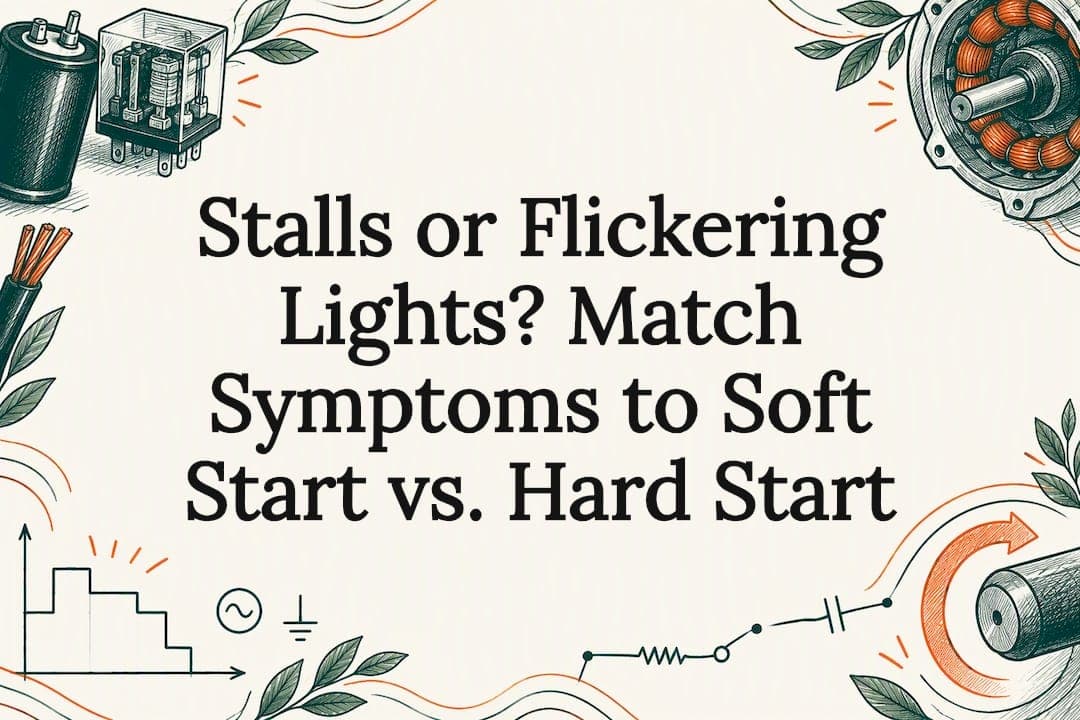
A hard start kit adds a brief jolt of torque to help a struggling compressor break free and spin up; a soft start controls voltage during startup to cut the electrical surge and protect your system. If the compressor is straining mechanically, you need a hard start. If breakers trip, lights dim, or you're running on a generator, you need a soft start. Watch for both signs before you decide, since they point to different problems entirely.
TL;DR:
- Hard start kits provide a brief torque boost to overcome mechanical resistance but do not reduce inrush current or electrical surge issues.
- Soft starters use phase-angle control to gradually ramp up voltage, significantly lowering inrush current while not increasing starting torque.
- Electrical symptoms like dimming lights and tripped breakers indicate inrush current problems, whereas humming or stalling suggests torque deficiencies requiring a hard start.
- Installing a soft starter upstream of a variable frequency drive can cause immediate damage, so they must be used carefully and correctly matched to the equipment.
- Diagnostic measurements, especially starting current and locked-rotor amperage, are essential before selecting either device to ensure it addresses the correct problem.
Table of Contents
- Soft Start vs. Hard Start: A Side-by-Side Look at the Trade-Offs
- How Hard Start Kits and Soft Starters Actually Work
- When to Choose a Hard Start vs. a Soft Start
- Compatibility Pitfalls That Cause Real Damage
- How Contractors Actually Diagnose This in the Field
- Diagnose the Problem Before You Install Anything
- Let Hita Handle the Diagnosis, Not Just the Part
- Where This Information Comes From
- Sources
- FAQ
Soft Start vs. Hard Start: A Side-by-Side Look at the Trade-Offs
The two devices solve completely different problems, even though they get lumped together in the same conversation constantly. A hard start kit is a torque solution. A soft starter is a current and voltage solution. Confusing the two is the single most common mistake homeowners and even some technicians make.
A hard start kit pairs a start capacitor with a relay (or, in cheaper versions, a PTCR device) to deliver a short burst of extra energy the moment the compressor motor engages. That burst helps the compressor overcome internal resistance, whether from refrigerant pressure that hasn't equalized or mechanical friction in an aging motor. It does its job in a fraction of a second, then drops out of the circuit entirely and does nothing to reduce the amount of current pulled from your electrical panel at startup. In some cases, it can momentarily increase peak demand.
A soft starter works on the opposite side of the equation. Using solid-state phase control, it ramps up the voltage delivered to the motor over one to several seconds rather than slamming it with full voltage instantly. That ramp reduces inrush current, the temporary spike that can dim your lights, strain a generator, or trip a breaker that's sized close to the margin. Industry references from ICM Controls note inrush reductions of up to 60 to 70% in some HVAC applications, which is why soft starters show up so often in generator-backed and off-grid installations.
Here's what changes with each device:
- Starting torque: Hard start increases it briefly. Soft start does not add torque; it can actually extend the time it takes the motor to reach full speed.
- Inrush current: Soft start reduces it significantly. Hard start has little to no effect on peak amperage draw.
- Noise and mechanical shock: Hard start can produce an audible "kick" as the compressor lurches to speed. Soft start produces a smoother, quieter ramp.
- Upfront cost: A hard start kit typically runs far less than an electronic soft starter, reflecting the gap in complexity between a passive capacitor and relay assembly versus a microprocessor-controlled device.
- Complexity: Hard start kits are simple, largely "set and forget" add-ons. Soft starters involve more wiring, sometimes programming, and a steeper learning curve for DIY installers.
Soft start advantages don't include fixing torque problems. If a compressor genuinely can't get moving, no amount of voltage ramping will help. That's a mechanical issue, not an electrical one.
Pro Tip: If you're not sure which problem you have, watch the compressor at startup. A hum-and-stall pattern points to torque. A dimming-lights-and-tripped-breaker pattern points to inrush current. They rarely overlap.
One more distinction matters for long-term planning: a hard start is often a stopgap. It buys time on a compressor that's starting to struggle, but it doesn't reverse wear. A soft starter, by contrast, is usually installed as a permanent fix for a structural electrical limitation, like running high-draw equipment on a generator or a panel with limited headroom. One treats a symptom. The other treats a system constraint.
How Hard Start Kits and Soft Starters Actually Work
A hard start kit is mechanically simple. It consists of a start capacitor wired in parallel with the motor's run capacitor, controlled by a relay (a potential relay in quality kits, or a PTCR in cheaper ones). When power hits the compressor, the start capacitor dumps a concentrated charge into the start winding, generating extra torque for a fraction of a second. Once the motor reaches roughly 75% of its running speed, the relay opens and disconnects the start capacitor from the circuit entirely. From that point on, the compressor runs on its regular run capacitor as if the hard start kit weren't there.
PTCR devices (positive temperature coefficient resistors) do something similar but through a different mechanism: they start with low resistance, heat up as current flows, and increase resistance until they effectively remove themselves from the circuit. They're cheaper and have no moving parts, but HVAC practitioners have documented PTCRs behaving less predictably than a true start capacitor and potential relay combination, especially over repeated cycles.
A soft starter operates on an entirely different principle. Instead of adding torque, it uses silicon-controlled rectifiers, or SCRs, arranged in back-to-back thyristor pairs to control the firing angle of the AC voltage waveform. In plain terms: the device chops the incoming voltage and only lets through a portion of each wave cycle at the start, then gradually widens that portion until full voltage is reached. That ramp, controlled by a microcontroller, is what smooths the electrical demand and cuts inrush current.
Soft starters use phase-angle control to ramp voltage, not frequency. That single distinction explains why they can't substitute for a variable frequency drive in applications that need speed control.
More advanced soft starters add features beyond a basic ramp: current-limiting modes that cap inrush at a fixed multiple of running current, torque control that shapes the acceleration curve to reduce mechanical stress on belts and couplings, and soft-stop functions that ramp voltage down at shutoff instead of cutting it abruptly.
Key mechanical differences to keep straight:
- Hard start kits add a component (start capacitor) and remove it after startup; soft starters stay in the circuit continuously, modulating voltage the entire time the motor runs at startup.
- Hard start kits affect torque; soft starters affect voltage and current, with torque as a secondary effect.
- Soft starters have no frequency control, which means they can't slow a motor down for variable-speed operation the way a VFD can. A soft starter that finishes its ramp effectively hands the motor full-voltage, full-frequency power, just like an across-the-line start, only reached gradually rather than instantly.
That last point trips people up constantly. A soft starter sounds like it should behave like a VFD, since both are electronic and both smooth out startup. They don't do the same job, and treating them as interchangeable causes real equipment damage, which the compatibility section below addresses directly.
When to Choose a Hard Start vs. a Soft Start
Matching the device to the actual problem takes a few minutes of observation. Here's the practical decision path technicians use in the field:
- Watch the compressor at startup. If it hums, struggles, and sometimes trips the internal overload without spinning up, that's a torque deficiency. Common causes include unequalized refrigerant pressure, worn motor windings, or a compressor that's simply aging out. This points toward a hard start.
- Check your electrical symptoms. If lights dim noticeably across the house, a breaker trips at the exact moment the compressor kicks on, or you're running the system off a generator that struggles at that instant, that's an inrush current problem. This points toward a soft starter.
- Consider your power source. Homes and cabins running on generators or off-grid inverter systems benefit disproportionately from soft starters, since generator capacity is often the binding constraint, not the compressor's mechanical condition.
- Rule out repair-first red flags. Metallic grinding or clicking noises, a compressor that short-cycles repeatedly even after starting, or signs of an oil-logged compressor are not start-assist problems. They're failure indicators. Installing either device on a compressor in mechanical decline just delays an inevitable and often more expensive replacement.
- When symptoms overlap, get an amperage reading before buying anything. A clamp meter on the compressor circuit during startup tells you whether the current spike is abnormal for your specific equipment, which settles the torque-versus-electrical question with data instead of guesswork.
Pro Tip: If your compressor is more than 10 to 12 years old and starting to hesitate, a hard start might get you through another season. Weigh that cost against a replacement quote before committing. Sometimes the "fix" costs nearly as much as buying time you don't actually want to buy.
The quick version: torque problem, mechanical hesitation, aging compressor, occasional hard start on a healthy unit. Electrical problem, generator power, breaker sensitivity, repeated inrush trips. Grinding noises or repeated short cycling: stop and call a technician before installing anything.
Compatibility Pitfalls That Cause Real Damage
Not every "soft start" product on the market is what it claims to be, and getting this wrong has consequences beyond a wasted purchase.
PTCR devices are frequently marketed and sold as hard start kits, but they lack the active switching of a true start capacitor and potential relay setup. They're a legitimate low-cost option, but HVAC practitioners have flagged them as less reliable over repeated startup cycles compared to a proper capacitor and relay combination. If you're buying a hard start kit, check the components list, not just the label on the box.
The bigger hazard involves soft starters and variable frequency drives together. Never install a soft starter upstream of a VFD. A soft starter's phase-controlled, chopped voltage output can destroy the VFD's input IGBTs (insulated-gate bipolar transistors), the semiconductor components that handle the drive's power conversion. This isn't a minor compatibility footnote. It's treated as an absolute rule among field technicians, because the failure mode is immediate and expensive.
- Confirm whether your system already has a control board with built-in soft-start or current-limiting logic before adding an aftermarket device.
- Check that any add-on device won't interfere with OEM protections, sensors, or diagnostic codes the manufacturer relies on.
- Size hard start kits to the manufacturer's specified capacitor microfarad rating and relay pickup voltage. Guessing on sizing here can cause the relay to stay engaged too long, overheating the start winding.
- Verify a soft starter's current rating matches or exceeds your compressor's locked-rotor amperage, not just its running amperage.
Manufacturer white papers consistently stress that installation errors, not device selection, cause the majority of field failures, which is why matching specs to your exact equipment matters more than the brand name on the box.
How Contractors Actually Diagnose This in the Field
Technicians rarely install a start-assist device on instinct. The standard approach starts with a clamp meter reading on starting current, compared against the compressor's rated locked-rotor amperage. That single measurement usually separates a torque issue from an electrical one before any parts get ordered.

A hard start typically gets recommended as a temporary bridge on an aging compressor that's still otherwise healthy, buying time until a planned replacement rather than masking a failure that's already underway. Soft starters get specified more deliberately, usually during generator-backed or off-grid installations, where the technician tests actual generator capacity against the compressor's startup draw before choosing a device. Preventive maintenance, including annual electrical checks, matters here too. Fewer hard starts over a compressor's life generally means less cumulative wear on start windings.
Diagnose the Problem Before You Install Anything
Homeowners often want a part number, not a diagnosis. That's backward. A hard start kit or soft starter should solve a problem you've actually confirmed, torque or current, not one you're guessing at. Measure first. If a compressor keeps struggling after a hard start is installed, that's usually a sign the compressor itself needs attention, not a bigger kit.
— John
Let Hita Handle the Diagnosis, Not Just the Part
There are options for homeowners who want a measured diagnosis instead of a guessed-at fix. Technicians can check starting current against specific equipment's rated draw, confirm whether the issue is mechanical or electrical, and recommend the correct device or repair based on that reading.
If your system has been tripping breakers, struggling to start, or you're planning a generator-backed setup, that's exactly the kind of diagnostic work worth getting right the first time. Hita's preventive maintenance and troubleshooting services cover exactly this kind of assessment, and if repeated hard starts are wearing down an aging compressor, enrolling in the Maine Heat Pump Care Plan at $319 per year keeps that system checked before small strain becomes a full replacement. For homes planning a new system from the ground up, Hita's installation planning process sizes equipment correctly from the start, based on real heat-loss calculations rather than guesswork. Reach out through the services page to get a diagnostic scheduled.
Where This Information Comes From
This comparison draws on manufacturer technical documentation from ICM Controls, field-practitioner guidance from HVAC School, and industry technical references on thyristor-based soft starters, verified against real installation and compatibility concerns.
Sources
- Soft-start vs. hard-start in HVAC | ICM Controls (2026)
- Potential for Good and Evil (The Hard Start & Potential Relay) - HVAC School
- IEEE / Machine Design technical reference on soft starters
FAQ
What Are the Disadvantages of Soft Starters?
Soft starters add cost and wiring complexity compared to a simple hard start kit, and they don't add torque, so they won't help a compressor that's mechanically struggling to turn. They also can't be installed upstream of a VFD, since the phase-controlled output risks damaging the drive's internal components.
Will a Soft Start Damage a Compressor?
A properly sized soft starter matched to your compressor's rated current shouldn't cause damage; its entire function is reducing electrical stress at startup. Damage risk comes from mismatched sizing or installing one where a VFD is already present downstream, not from the soft-start function itself.
Do I Need a Soft Start on My AC for a Generator?
If your generator struggles at the exact moment the compressor kicks on, causing flickering, stalling, or shutdown, a soft starter is usually the right fix, since it can cut inrush current by a wide margin according to ICM Controls. Testing your generator's actual capacity against the compressor's startup draw first confirms whether it's genuinely needed.
Which Is Better, Soft Start or Easy Start?
"Easy start" is a brand name used for certain soft-start products, so the comparison usually comes down to soft start versus hard start rather than a genuine third category. Neither is universally "better"; the right choice depends on whether your system has a torque problem or an inrush current problem.
Is a Hard Start the Same as Direct Online Starting?
No. Direct online (across-the-line) starting sends full voltage to the motor instantly with no assist at all, while a hard start kit adds a brief torque boost during that same instant startup. A soft starter, by contrast, replaces the instant full-voltage hit with a gradual ramp, which is the real point of comparison against direct online methods.