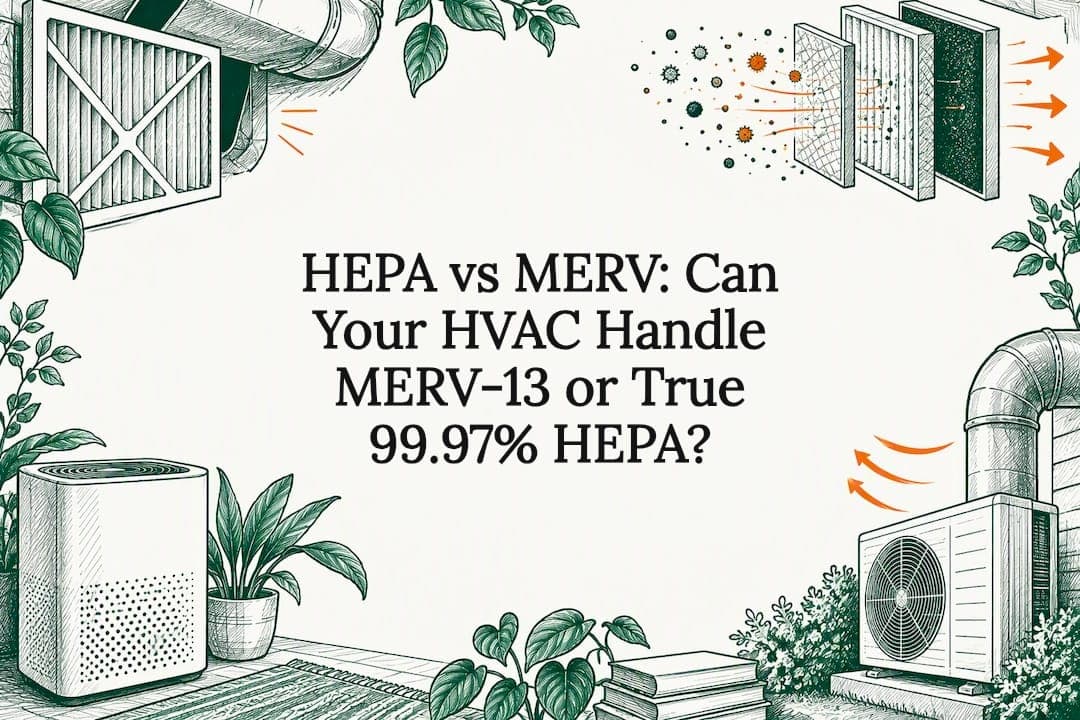
HEPA filters are defined by the US EPA as capturing at least 99.97% of particles at 0.3 microns, while MERV is a separate 1-16 scale developed by ASHRAE to rate general ventilation filters. The practical rule: reach for a portable HEPA unit when you want the highest possible capture in a single room, and reach for a MERV upgrade when you want whole-house filtration through your existing HVAC system, provided that system can handle it. Installing true HEPA media inside a standard residential duct system usually is not possible without redesigning the equipment.
TL;DR:
- Most residential HVAC systems can typically handle MERV-13 filters, but using higher ratings like HEPA requires system modifications to prevent airflow issues.
- Portable HEPA units are effective for quickly cleaning the air in individual rooms, especially during smoke events or allergy seasons.
- Upgrading to MERV-13 filters throughout the house offers better long-term protection but may increase energy costs and wear on existing HVAC systems.
- Filter efficiency varies by particle size, with HEPA capturing at least 99.97% of 0.3 micron particles, often trapping smaller particles more effectively.
- Proper maintenance, including verifying system capacity and schedule filter replacements, is crucial to ensure filtration performance and system longevity.
Table of Contents
- What MERV and HEPA actually measure
- How filtration efficiency compares across particle sizes
- Why higher filtration can strain your HVAC system
- Portable HEPA units versus HVAC filter upgrades in practice
- Weighing the trade-offs between HEPA and high-MERV filters
- A practical checklist before you upgrade
- A simple way to remember the difference
- FAQ
- Sources
- Keep your filtration working as designed
What MERV and HEPA actually measure
MERV, short for Minimum Efficiency Reporting Value, came out of ASHRAE testing protocols and runs from 1 to 16, with higher numbers meaning better capture of smaller particles. Each rating reflects performance across a range of particle sizes, not a single number pulled from marketing copy.
HEPA works differently. It is not a point on the MERV scale at all. The designation comes from the Department of Energy, which set the requirement that a true HEPA filter remove at least 99.97% of particles at 0.3 microns, the size considered most penetrating for this type of media. That is why a HEPA filter is not simply "a MERV 20" or some number beyond the chart: the two systems use different test methods, different airflow conditions, and different certification processes entirely.
This distinction matters when you are shopping. A product label that says "HEPA-type" or "HEPA-like" has not met the DOE threshold and should not be treated as equivalent to certified HEPA media.
How filtration efficiency compares across particle sizes
Efficiency numbers only mean something when you know what particle size they describe. MERV ratings report performance across bands from roughly 0.3 to 10 microns, and ASHRAE's own guidance recommends MERV-13 filters where feasible because of how much more they capture in the smaller particle ranges compared to basic filters.
Rough patterns across the scale look like this:
- Lower MERV filters (roughly 1-8) mainly catch larger particles such as dust, pollen, and lint, with weak performance on fine particles.
- Mid-range filters (MERV 9-12) start capturing mold spores and some fine dust more consistently.
- MERV 13 and above capture a meaningfully higher share of fine particles, including much of the 0.3 to 1.0 micron range, which is why ASHRAE points to it for infection-control purposes.
HEPA media is tested specifically at the most penetrating particle size, and particles both larger and smaller than that size are captured at equal or higher efficiency. A common misconception is that HEPA filters let sub-0.3 micron particles through unchecked. In practice, those smaller particles are captured through diffusion effects and tend to be trapped even more effectively than the 0.3 micron benchmark particle itself.
Why higher filtration can strain your HVAC system
Every filter creates resistance to airflow, known as pressure drop, and that resistance increases with denser media and higher MERV ratings. Pleat depth, filter area, and the blower's rated capacity all determine how much resistance a system can absorb before performance suffers.
Most residential HVAC systems are typically rated for filters up to around MERV 13, and HEPA media usually falls outside what a standard residential air handler can accommodate without modification. Pushing a system beyond its design limits can mean:
- Reduced airflow throughout the home, leading to uneven heating or cooling.
- Higher energy use as the blower works harder against the added resistance.
- Increased wear on the fan motor, which can shorten its service life.
Pro Tip: Check the filter slot depth and the manufacturer's maximum MERV rating printed on your air handler before buying a new filter, and when in doubt, have a technician confirm the system can handle it.
If you are planning a larger HVAC project or a heat pump upgrade, a professional assessment of your system's capacity is a reasonable step before committing to higher-efficiency filtration.
Portable HEPA units versus HVAC filter upgrades in practice
The right choice often depends on the scenario. During wildfire smoke events or for people managing allergies, a portable HEPA unit placed in a bedroom or living room tends to deliver faster, more concentrated particle reduction than waiting on whole-house airflow to cycle through a central filter.
For infection control in shared spaces, whole-home upgrades have shown real benefit too. A transit and building study found that moving from MERV-8 to MERV-13 filtration reduced the estimated probability of infection by around 41% compared to the lower-rated filter.
MERV-13 HVAC filtration cut estimated infection probability by a substantial percentage compared to MERV-8 in a passenger railcar study, a meaningful gap for a filter swap that does not require new equipment.
Separately, NIOSH testing on do-it-yourself box-fan MERV-13 setups found they substantially reduced aerosol exposure, though the agency still points to certified commercial units for long-term, permanent use rather than DIY builds.
In short: for occasional, room-specific needs, portable HEPA wins on speed and concentration. For continuous whole-house protection, a MERV-13 upgrade within your system's limits is often the more practical fix.

Weighing the trade-offs between HEPA and high-MERV filters
Each option comes with real costs beyond the sticker price.
- HEPA units capture particles at a very high rate but are limited to the room they sit in, can be noisy on higher fan settings, and add an upfront appliance cost plus ongoing filter replacement.
- High-MERV HVAC filters cover the whole house passively but increase pressure drop, may need more frequent replacement than lower-rated filters, and can shorten blower life if the system was not designed for them.
- Both types lose effectiveness if not sealed and replaced on schedule, and pleat depth affects how much particulate a filter can hold before airflow drops off.
Neither option is a complete fix on its own. The EPA's guidance on ventilation notes that filtration works best paired with fresh air exchange and controlling pollutant sources at the start.
A practical checklist before you upgrade
Start by defining the goal: do you need to clean the air in one room, or across the whole house? That answer shapes everything else.
- Measure the room if you are considering a portable unit, and match it to a clean air delivery rate suited to that square footage.
- Pull your HVAC system's filter slot depth and manufacturer-listed maximum MERV rating before buying a replacement filter.
- Ask any HVAC technician directly about pressure-drop specs, the system's recommended MERV ceiling, and whether the filter housing seals tightly enough to prevent bypass air.
Pro Tip: Run your HVAC fan more continuously (not just on thermostat calls) during smoke events or high pollen days to pull more air through whatever filtration you have in place.
Keep windows closed during outdoor air quality events, and replace filters on the schedule the manufacturer lists rather than waiting for visible buildup. For readers managing a heat pump system, routine cleaning and care plans help keep filtration and airflow performing as designed between replacements.
A simple way to remember the difference
If you take one thing from this: portable HEPA for the room you spend the most time in, MERV-13 for the whole house if your HVAC system can take it, and neither one replaces fresh air. Open windows when you can, fix the pollutant at its source when possible, and get a professional opinion before pushing your HVAC system past its design limits.
— John
FAQ
Is a MERV 16 filter the same as a HEPA filter?
No. The MERV scale tops out at 16, and HEPA is a separate DOE-defined standard rather than a point on that scale.
Is MERV 11 too high for a typical home?
Not usually. Most residential HVAC systems tolerate filters up to MERV 13, though some older or smaller systems may see a noticeable drop in airflow. Checking your system's manufacturer specifications or asking a technician is the safest way to confirm before installing it.
Is HEPA the same as MERV 17 or higher?
The MERV scale ends at 16, and HEPA filters are certified under separate DOE guidance rather than assigned a MERV number.
What are the downsides of using a HEPA filter?
Portable HEPA units are limited to the room they sit in and need regular filter replacement to stay effective, which adds ongoing cost. They can also be audible on higher fan speeds, and true HEPA media generally cannot be retrofitted into standard residential ductwork without modifying the system.
Should I buy a portable HEPA unit or upgrade my HVAC filter?
If your main concern is one frequently used room, such as a bedroom during wildfire smoke season, a portable HEPA unit typically delivers faster results. If you want continuous whole-house coverage and your system can handle it, a MERV-13 upgrade is often the more practical route, and a heat pump system assessment can confirm whether your equipment supports it.
Sources
- What is a HEPA filter? | US EPA
- Debunking Myths About MERV, Air Filtration | ASHRAE
- Experimental studies of particle removal and probability of COVID-19 infection in passenger railcars
- NIOSH DIY air filtration evaluation
Keep your filtration working as designed
Choosing the right filter only pays off if the system behind it stays in good shape, and that is where regular upkeep matters as much as the filter rating itself. We handle heat pump installation, change-outs, and deep cleaning, sizing every system to real heat-loss calculations rather than guesswork, so your filtration and airflow perform the way they are supposed to in a climate that does not leave room for error.
For ongoing peace of mind, our Annual Cleaning Plan runs $219 per year and our Maine Heat Pump Care Plan runs $319 per year, both built to keep filtration, airflow, and system performance on track between visits. If you are planning a new system or replacing an aging one, service availability is confirmed by ZIP code before scheduling to provide an accurate answer instead of a statewide guess. Get a free assessment through our services page and find out what your home actually needs.

For broader indoor air strategies beyond filtration, including ventilation and source control, see this indoor air quality guidance.