For short, frequent outages, a battery backup (ideally paired with solar) usually wins on cost, quiet, and daily-use value. For multi-day storms and whole-home heating loads, a standby generator still runs circles around a battery. The real trade-off is runtime versus everyday payoff: generators deliver near-unlimited power as long as fuel lasts, while batteries deliver instant, silent power for a fixed number of hours. Read the sizing and safety sections below before you call a contractor.
TL;DR:
- Batteries paired with solar panels often have lower total costs over 10 years compared to standby generators if outages are short and infrequent, especially with federal tax incentives.
- Generators, particularly standby units, are better suited for long outages exceeding a day or heavy loads like heating, offering unlimited runtime with fuel supply.
- For sensitive electronics or medical devices, batteries with UPS or rapid switching are essential to prevent glitches during generator startup delays.
- Proper sizing relies on real utility outage data; oversizing leads to unnecessary costs, while undersizing may compromise power during outages.
- Hybrid systems combining both battery and generator provide seamless critical load coverage for extended outages, but require careful maintenance and planning.
Table of Contents
- Generator vs Battery Backup: How Each System Actually Works
- What a Generator vs Battery Backup Really Costs Over Time
- How Long Will It Actually Run? Making Sense of kW and kWh
- Generator Advantages vs Battery Backup Drawbacks, Side by Side
- Permits, Codes, and the Safety Checklist Contractors Should Walk You Through
- Which Backup Option Fits Your Home? A Decision Framework
- The Hybrid Setup: Battery for the First Hour, Generator for the Long Haul
- A Publisher's Take on Planning Backup Power the Right Way
- Where to Verify These Numbers Yourself
- Sources
- FAQ
Generator vs Battery Backup: How Each System Actually Works
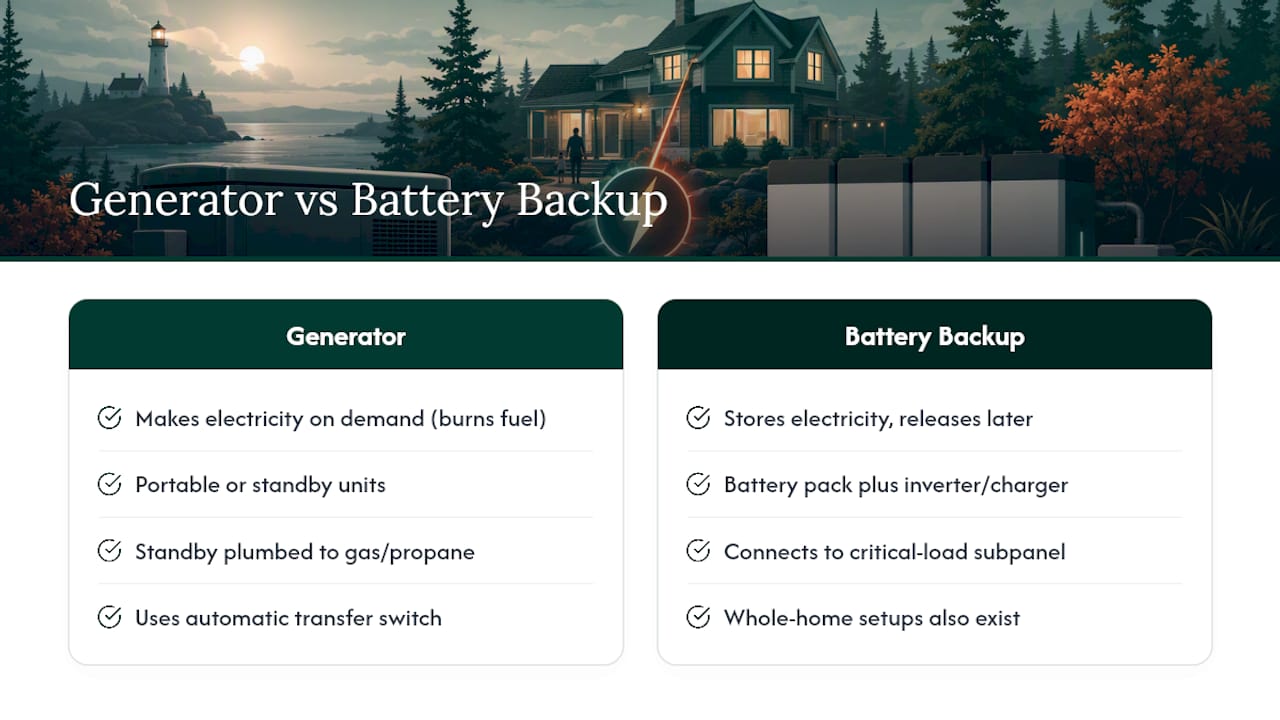
A generator makes electricity on demand by burning fuel. A battery backup stores electricity made earlier and releases it later. That distinction drives almost every other difference between them.
Generators come in two flavors. Portable units run on gasoline and get wheeled out during an outage, plugged into select circuits. Standby generators sit permanently outside the house, plumbed into natural gas or propane, and switch on automatically through an automatic transfer switch. Standby units typically start within 10 to 30 seconds of a utility outage, since the transfer switch has to detect the loss of grid power, signal the generator to start, and swing the electrical load over.
Battery backup systems are built around a battery pack, an inverter or combined inverter/charger, and a load panel. Most residential setups connect to a critical-load subpanel rather than the whole house, though whole-home battery configurations exist. Many are charged by solar panels during the day and discharge at night or during an outage, switching over in milliseconds rather than seconds.
That millisecond switchover matters for one category of equipment: sensitive electronics. Medical devices, desktop computers, and some smart-home hubs can glitch or reset during even a brief generator startup delay. If you run this kind of equipment, a small uninterruptible power supply (UPS) bridges that gap regardless of which backup system you choose.
What a Generator vs Battery Backup Really Costs Over Time
Sticker price is only half the math. The other half is what you spend to keep either system running for the next decade.
Portable generators typically cost several hundred to a few thousand dollars, installed, though "installed" is a stretch since most just get rolled out and plugged in. Standby generators, complete with the transfer switch, gas line work, and a concrete pad, typically cost several thousand to mid five figures. Battery backup paired with solar tends to run $15,000 to $30,000 installed for a whole-home-capable setup, according to cost and performance data tracked by NREL's residential battery storage benchmarks. A single critical-load battery unit without solar costs considerably less.
That gap narrows fast once incentives enter the picture. Battery systems charged by solar can often qualify for the federal Investment Tax Credit, which knocks a meaningful percentage off the net installed cost. Generators get no equivalent federal credit, since they burn fuel rather than store renewable generation.
Ongoing costs tell a similar story in reverse of the upfront numbers:
- Standby generators need annual maintenance (oil changes, filter swaps, battery checks) plus fuel costs during actual use, often $200 to $500 a year in upkeep alone.
- Portable generators need fuel stockpiling and more frequent hands-on maintenance since they lack automatic self-test cycles.
- Battery systems have close to zero fuel cost and minimal moving parts, so annual maintenance is largely a matter of software updates and occasional inspection.
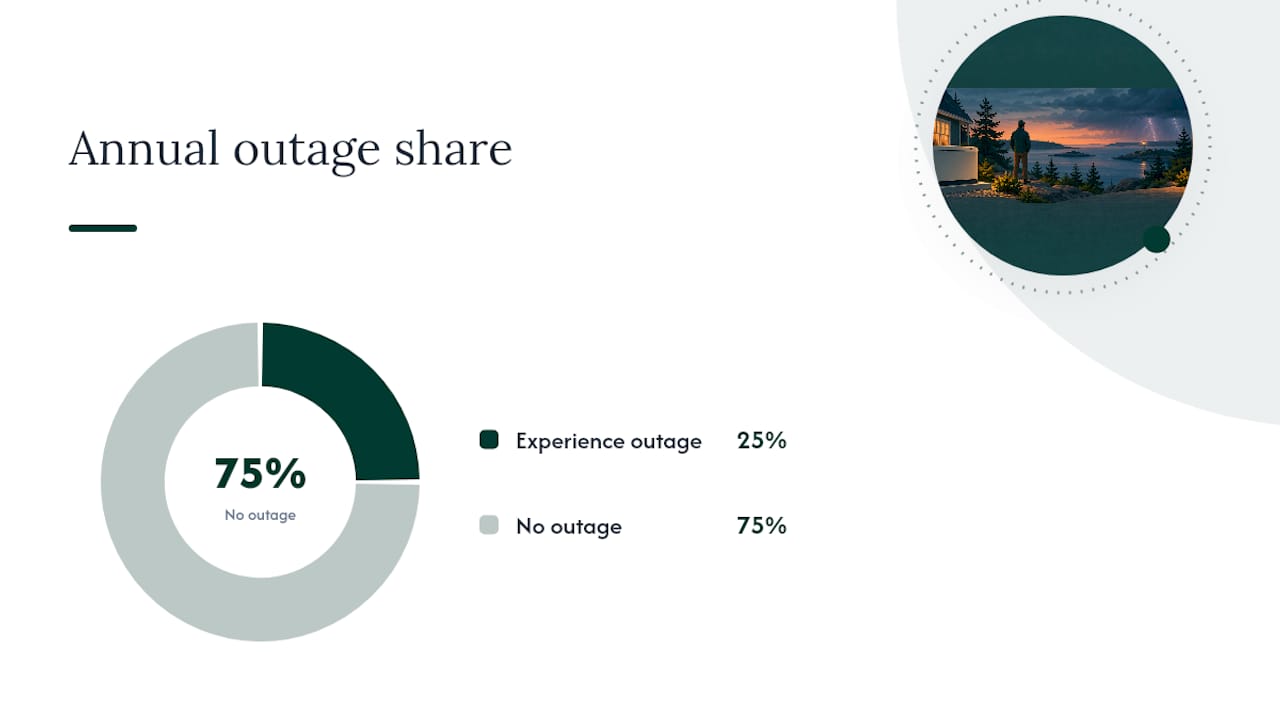
The rough math homeowners should know: if your outages are typically short (a few hours to a day) and you already have or plan to add solar, a battery's 10-year total cost, after the ITC, often comes out close to or below a standby generator's installed price plus a decade of fuel and service. If your outages regularly stretch past a day or two, the generator's lower upfront cost and unlimited runtime usually wins on pure economics. About 1 in 4 U.S. households experience a power outage in a given year, so this isn't a hypothetical decision for most homeowners.
How Long Will It Actually Run? Making Sense of kW and kWh
Two numbers determine what a backup system can do: kilowatts (kW), which measure power, the rate of energy flow, and kilowatt-hours (kWh), which measure energy, the total amount stored or available. A generator is rated in kW and, as long as fuel keeps flowing, that power output doesn't run out. A battery is rated in both kW (how much it can deliver at once) and kWh (how long it can deliver it), and once the kWh is drained, it's dead until recharged.
Here's what that means in practice:
- Portable generators typically output 3 to 8.5 kW, enough for a refrigerator, some lighting, and a sump pump, but not a central heat pump or electric range simultaneously.
- Standby generators commonly range from 10 to 24 kW, which covers most whole-home loads including HVAC, water heaters, and kitchen appliances.
- A single residential battery unit usually stores around 10 to 15 kWh, per industry sizing data, enough to run critical loads like a refrigerator, some lights, and a few outlets for several hours.
- Whole-home battery coverage generally requires stacking two, three, or more units, since one unit's kWh capacity drains quickly once you add a well pump, electric water heater, or heat pump into the mix.
That last point is the one homeowners underestimate most. A heat pump during power outage conditions can pull more sustained load than people expect, since it's running compressors and fans continuously rather than cycling briefly like older resistance heat systems. If keeping the house warm during power outage events matters to you (especially in cold Maine winters), size any battery system around your actual heating load, not just lights and refrigeration. DOE's guidance on balance-of-system equipment notes that batteries need charge controllers and inverters sized to the loads they're expected to carry, not just the loads you'd like them to carry.
Generator Advantages vs Battery Backup Drawbacks, Side by Side
Both systems solve the same problem in opposite ways, and the daily experience of owning one differs more than most buying guides admit.
- Noise: Portable and standby generators run 60 to 75 decibels at full load, loud enough to draw neighbor complaints or trip HOA noise rules. Battery systems are silent.
- Emissions and safety: Combustion generators produce carbon monoxide and must run outdoors with clear ventilation. Battery systems carry no CO risk but need siting that follows NFPA 855 standards for energy storage systems, since lithium-ion batteries carry their own fire and chemical-gas considerations.
- Maintenance: Generators need oil changes, filter swaps, and periodic load testing. Batteries need almost nothing beyond a software check and visual inspection.
- Life span: Standby generators typically last 15 to 20 years with maintenance. Battery packs are usually warrantied for 10 years and retain most of their capacity through that window.
- Daily value: Batteries paired with solar can shift electricity use to avoid peak utility rates (time-of-use arbitrage) and some utilities pay homeowners to let batteries participate in virtual power plant programs. Generators sit idle and provide zero value until the power actually fails.
Pro Tip: Match your backup choice to your region's actual outage pattern, not a worst-case scenario. Pull your utility's outage history for your ZIP code before deciding. A homeowner who loses power for two hours a handful of times a year has a very different math problem than one who loses it for four days during an ice storm.
Permits, Codes, and the Safety Checklist Contractors Should Walk You Through
Both systems are regulated for good reason, and skipping the paperwork is how homeowners end up with failed inspections or, worse, actual hazards.
Battery energy storage systems fall under NFPA 855, the national standard governing where and how batteries can be installed, including clearances from doors, windows, and combustible materials. Your local Authority Having Jurisdiction (AHJ) enforces permitting and inspection, and the equipment itself needs to carry recognized safety listings such as UL 9540 for the system and UL 1973 for the battery itself. DOE's own compliance guidance stresses that non-listed or second-use battery assemblies create real permitting headaches, so insist on manufacturer-listed equipment.
Generators carry a different but equally serious risk profile: carbon monoxide. Standby units must sit outdoors, away from windows, doors, and soffit vents, with clearances specified by the manufacturer and local code. Portable generators cause the most CO poisoning incidents because people run them too close to the house or, worse, indoors or in garages.
Budget for the add-ons beyond the unit itself:
- Gas line extension or propane tank setup for standby generators.
- A concrete or composite pad for the generator to sit on.
- An automatic transfer switch (standby) or manual interlock kit (portable).
- Panel upgrades or a dedicated critical-loads subpanel for battery systems.
Before signing a contract, ask your installer for the AHJ permit timeline, the specific UL listings on the equipment, and written clearance measurements for your property.
Which Backup Option Fits Your Home? A Decision Framework
Answer these questions honestly before you request quotes, since the right answer for your neighbor might be wrong for you.
- How long do your outages typically last? Under a day, lean battery. Multiple days, lean generator or a hybrid setup.
- How often do outages happen? A few times a year favors a quiet, zero-maintenance battery. Rare but severe events favor generator runtime.
- Do you need whole-home coverage or just essentials? Whole-home battery coverage multiplies unit count and cost fast; a critical-loads panel keeps battery costs manageable.
- Do you have or plan to install solar? Solar-paired batteries get the ITC and daily bill savings; batteries without solar lose much of their financial edge.
- Are noise or emissions a concern? HOA rules, close neighbors, or personal preference can rule out combustion generators entirely.
- Does anyone in the home rely on medical equipment? That usually pushes toward generator or hybrid coverage, since indefinite runtime matters more than switchover speed.
Rough profiles fall out of those answers. Short, occasional outages with existing or planned solar point toward a battery. Long outages, no solar, and heavy heating or cooking loads point toward a generator. Medical-equipment households often end up hybrid, for both the instant switchover and the extended runtime.
Before requesting quotes, gather your utility's 8760 hourly usage data (or 12 months of bills), a panel map showing your circuits, and confirmation of fuel availability (natural gas line, propane delivery, or storage space) at your address.
The Hybrid Setup: Battery for the First Hour, Generator for the Long Haul
A growing number of homeowners skip the either/or entirely. A hybrid system pairs a battery for instant, silent coverage of critical loads with a generator as backstop once the battery's stored energy runs low, which is a common and practical compromise for anyone who wants both quiet daily operation and multi-day insurance.
The typical pattern: the battery covers the first hours of an outage seamlessly, no noise, no startup delay. If the outage stretches past what the battery can sustain, the generator kicks in (either automatically or manually) to recharge the battery and carry heavier loads like HVAC.
Combined systems generally land in the $20,000 to $40,000 range installed, depending on generator size and battery capacity. Owners should plan for two maintenance cadences: monthly battery software checks and semiannual generator service, plus periodic fuel rotation for portable units and a test run of the standby generator every month regardless of season.
A Publisher's Take on Planning Backup Power the Right Way
The single biggest mistake homeowners make is sizing backup power off gut instinct instead of actual data. Pull 12 months of utility bills, or better, request 8760 hourly data from your utility, before you talk to a single contractor. That number tells an installer exactly how many battery units or how large a generator you truly need, instead of a guess padded for safety margin you're paying for and never using.
Work with a licensed electrician and loop in your local AHJ early, not after equipment shows up. Get itemized quotes, written warranty terms, and ask whether the installer offers ongoing maintenance. Hitamaine's own heat pump installation and maintenance services reflect that same principle: proper sizing up front prevents expensive surprises later, whether you're planning heating equipment or backup power.
— John
Where to Verify These Numbers Yourself
Trust the primary sources, not secondhand summaries. These are the ones worth bookmarking:
- U.S. Census outage data: the real numbers behind how many households lose power annually.
- DOE's Energy Storage Safety Strategic Plan: the federal safety framework behind battery installation rules.
Sources
- Power outages were widespread in 2023 (U.S. Census story)
- Energy Storage Safety Strategic Plan (DOE)
FAQ
Which power backup is best for a home?
It depends on your outage pattern more than anything else. Homes with short, frequent outages and existing solar tend to do best with a battery backup, while homes facing long, multi-day outages or heavy whole-home heating loads usually get better value from a standby generator.
What is the cheapest way to power my home during an outage?
A portable generator is the cheapest upfront option, typically several hundred to a few thousand dollars, though it only covers a handful of circuits and needs fuel on hand. For zero-maintenance, no-fuel coverage of essentials, a smaller critical-load battery unit without solar is often the next cheapest path.
Do I need a UPS if I have a generator?
Yes, if you run sensitive electronics like medical devices or desktop computers. A standby generator's automatic transfer switch takes roughly 10 to 30 seconds to kick in, and that gap can disrupt equipment that needs truly uninterrupted power.
Can a battery-powered generator run a house?
A single residential battery unit, storing roughly 10 to 15 kWh, can typically run critical loads like a refrigerator, lighting, and a few outlets for several hours, but not a whole home. Whole-home coverage usually requires stacking multiple battery units, which raises cost quickly.