
A floor-mounted mini split is a ductless indoor console, roughly the size of a small radiator, that pairs with an outdoor condensing unit to heat and cool a room from floor level instead of up near the ceiling. It's the right pick when wall space is scarce, when you're replacing an old radiator under a window, or when you want warm air circulating where your feet actually are. Whatever room you're targeting, get the capacity checked against a real heat-loss estimate before you buy.
TL;DR:
- Proper sizing based on a full heat-loss calculation is crucial, especially in cold climates like Maine, to ensure consistent heating and system longevity.
- Units with low-temperature heating ratings below −13°F are available, but they must be correctly matched to the home's heat loss rather than just square footage.
- Choose models with high SEER2 ratings and inverter-driven compressors to maximize efficiency and reduce energy costs.
- Installation requires attention to clearance, condensate drain routing, and matching outdoor and indoor units, with professional HVAC input for refrigerant work.
- Regular maintenance, such as filter cleaning and annual professional checks, extends the system's lifespan and maintains efficiency.
Table of Contents
- When a Floor-Mounted Mini Split Is the Best Choice
- What Specs Actually Matter on the Product Page
- How Big a Unit Do You Actually Need?
- Getting the Installation Right
- What It Actually Costs to Run
- Keeping It Running: Maintenance You Can and Can't Skip
- Why Cold-Climate Sizing Isn't Optional in Maine
- The Real Trade-Off Nobody Puts on the Spec Sheet
- Ready to Size and Install the Right System for Your Home
- Sources
- FAQ
When a Floor-Mounted Mini Split Is the Best Choice
Floor consoles solve a specific problem: rooms where a high-wall unit doesn't fit or doesn't make sense. Short knee walls, dormered ceilings, and older homes with radiators tucked under every window are the classic candidates. Because these units sit low, warm air rises through the space the way old-fashioned radiant heat did, which people in drafty New England houses tend to notice immediately.
- Advantages: low-level heat where you feel cold first, fits below windows without blocking the view, works well in historic rooms where high walls are off-limits.
- Trade-offs: airflow moves differently than a high-wall unit, so very large or high-ceilinged rooms may take longer to even out in temperature.
- Good fits: sunrooms with lots of glass, finished basements, additions built without ductwork.
If your main goal is quite background heat in a den or a converted porch, a floor console usually outperforms a ceiling-mounted equivalent simply because it's closer to where you sit.
What Specs Actually Matter on the Product Page
Every manufacturer page throws numbers at you. Here's what to actually read before comparing models.
- BTU capacity tells you raw heating and cooling power. Bigger isn't automatically better; oversized units short-cycle and waste energy.
- SEER2 and EER measure seasonal cooling efficiency. Some current floor console models advertise SEER2 ratings above 20, a meaningful jump from older single-digit window units.
- Low-temperature heating rating is the number cold-climate buyers should stare at longest. It's the outdoor temperature at which the unit still delivers rated heat output, not just "runs."
- Refrigerant type (R454B or R32 in newer models) affects servicing requirements and long-term availability of parts.
- Noise level, filter access, and app or remote controls round out the comparison.
Quick fact: Some floor console lines, including Fujitsu's RLFFH series, advertise heating performance down to around −15°F, a spec that matters far more in Maine than a marketing brochure's SEER number.
Single-zone units pair with one outdoor unit; multi-zone setups let one outdoor condenser feed a floor console plus other indoor heads, but capacity has to be split correctly across all of them.
How Big a Unit Do You Actually Need?
Floor console capacity typically runs across a range that accommodates common room sizes, matching what you'll see across most manufacturer lineups. A rough square-footage guide gets you in the ballpark:
- 9,000 to 12,000 BTU — bedrooms, small additions, roughly 300 to 550 square feet.
- 12,000 to 18,000 BTU — living rooms, sunrooms, open dens, roughly 550 to 1,000 square feet.
- 18,000 to 24,000 BTU — larger open-concept spaces or rooms with poor insulation, up to around 1,000 to 1,200 square feet.
Those numbers shift fast once you factor in high ceilings, single-pane windows, poor insulation, or a Maine winter that regularly dips below zero. A room that "should" need 9,000 BTU on paper can demand 12,000 once you account for four large windows and an uninsulated crawlspace underneath.
Pro Tip: Don't eyeball this one. An undersized unit runs constantly and never quite catches up; an oversized one short-cycles, wearing out components faster and leaving the room feeling humid. A proper heat-loss calculation accounts for insulation, window count, and orientation, not just square footage.
Getting the Installation Right
A floor console mounts under a window, half-recessed into a wall cavity, or fully surface-mounted, and each option changes the clearance you need for airflow and service access. Here's what to line up before install day:
- Confirm clearance in front of and above the unit so filters and coils stay reachable.
- Plan the condensate drain route, since floor units often need a pump if gravity drainage isn't an option.
- Match the outdoor condensing unit to the indoor console's BTU rating exactly, and check the maximum line-set length the manufacturer allows.
- Verify the electrical circuit meets the unit's voltage and amperage requirements before the crew shows up.
Some of this is DIY-friendly prep work. None of the refrigerant handling is. Anyone charging or evacuating line sets needs EPA Section 608 certification, and most states require a licensed HVAC contractor to pull permits anyway.
Before requesting an estimate, have this ready:
- Room dimensions and ceiling height
- Photos of the wall or window area you're targeting
- Your current heating type (baseboard, forced air, radiator)
- Any known insulation issues or drafty spots
Showing up with that information turns a vague estimate into an accurate one.
What It Actually Costs to Run
SEER2 and low-temperature heating ratings both feed into your electric bill, but in different ways. SEER2 predicts cooling-season efficiency; the low-temp rating predicts how hard the compressor works, and how much power it draws, on the coldest heating days. A unit rated efficient at 47°F can behave very differently at 5°F, which is why the low-temp spec deserves more attention than most buyers give it.
Worth knowing: Inverter-driven compressors, standard on most current floor console models, ramp output up and down instead of switching fully on and off. That's the mechanism behind the higher SEER2 numbers you'll see advertised.
- Zone only the rooms you actually heat, rather than running a whole-house system at full tilt.
- Use programmable schedules instead of constant manual adjustment.
- Seal drafts and add insulation where you can. Efficiency ratings assume a reasonably tight envelope.
- Keep filters clean. A clogged filter forces the unit to work harder for the same output.
Keeping It Running: Maintenance You Can and Can't Skip
Floor consoles are built for easy front access, which means most routine upkeep doesn't require a technician.
- Clean or rinse the filter every few weeks during heavy-use season. Most floor units use a washable filter behind a front panel that pops out without tools.
- Check the indoor coil visually for dust buildup once a season.
- Inspect the condensate pan and drain line for clogs, especially in humid months.
Beyond that, plan on a professional visit once a year, or twice for units running hard through both summer and winter. A tech will check refrigerant charge, clean the outdoor coil, and catch early signs of a failing capacitor or a sensor drifting out of calibration.
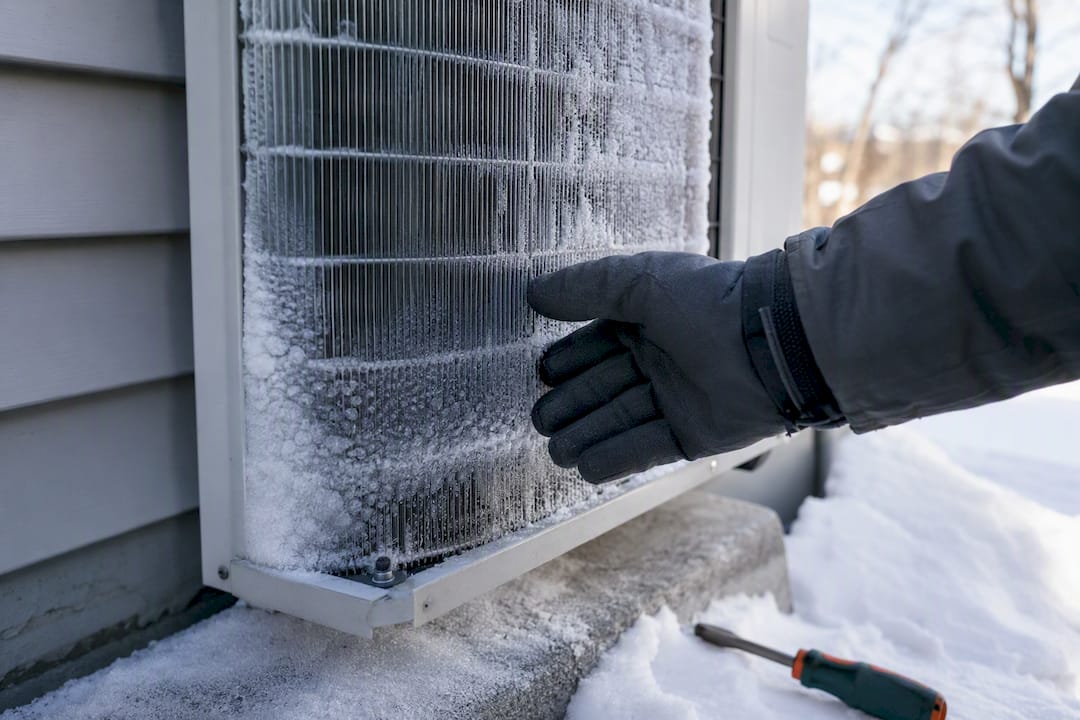
Pro Tip: A unit that's icing up on the outdoor coil in mid-winter isn't necessarily broken. It could be a defrost cycle problem worth a service call before it turns into a compressor issue.
Why Cold-Climate Sizing Isn't Optional in Maine
Most mini split marketing is written for mild climates, and that's exactly where a lot of Maine installs go wrong. A unit that's technically rated to heat at −13°F on a spec sheet still needs to be sized to the specific house, not just the square footage, to deliver that performance reliably on the coldest night of the year.
Hitamaine builds every installation around a full heat-loss calculation rather than a rule-of-thumb estimate, which is the difference between a unit that struggles at 10°F and one that doesn't. The company has extensive experience and has observed what undersizing does to comfort and to compressor lifespan over a Maine winter.
- Heat-loss based sizing instead of square-footage guessing
- Annual and biannual care plans that catch small issues before they become compressor failures
- Rebate guidance so buyers understand what incentives actually apply to their project
A properly sized system, backed by regular maintenance, tends to hold its efficiency rating for years instead of degrading quietly the way an oversized or neglected unit does.
The Real Trade-Off Nobody Puts on the Spec Sheet
Most buying guides treat floor-mounted mini splits like a wall unit that happens to sit lower. That's the wrong mental model. A floor console changes how heat moves through a room, and that matters more in a cold climate than in a mild one.
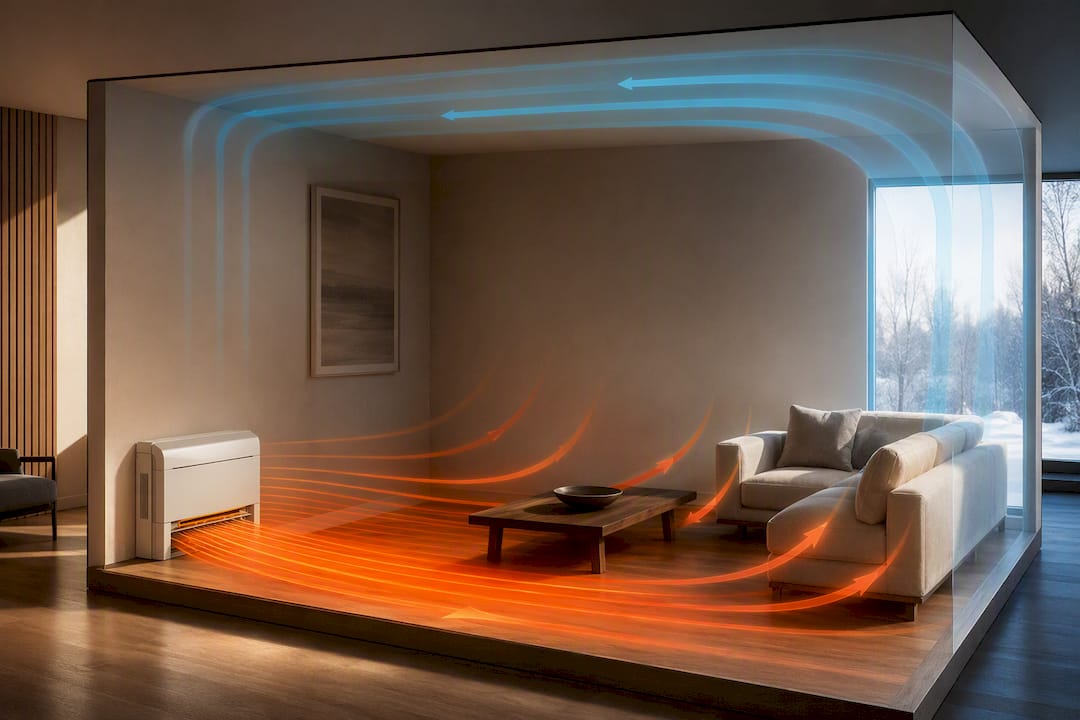
The conventional advice, "match BTU to square footage," gets people into trouble every winter. Square footage says nothing about how much heat a room loses through a leaky sill or a north-facing window. Two rooms of identical size can need wildly different capacity, and a spec-sheet low-temperature rating only means anything if the unit was sized correctly to begin with. An 18,000 BTU unit rated to −13°F will still underperform in a poorly insulated room, because the rating assumes the unit is matched to the actual heat loss, not oversized or undersized to compensate for guesswork.
What should actually drive the decision is where you feel cold, what your walls and windows are doing to that room, and whether you're willing to get a real heat-loss number instead of a tape-measure estimate. DIYers can absolutely handle the clearance planning, the paperwork prep, and the filter maintenance. The refrigerant work and the sizing math belong to a licensed pro, every time, no exceptions worth taking.
— John
Ready to Size and Install the Right System for Your Home
A reliable route to a floor console sized for your actual house involves starting from a heat-loss calculation instead of a rule of thumb rather than a generic square-footage guess.
That approach applies across the board: new installations, full change-outs of an aging system, one-time deep cleanings, and ongoing care through the Annual Cleaning Plan or the Maine Heat Pump Care Plan. An estimate includes a heat-loss check, a walkthrough of equipment options that actually fit your climate zone, and a look at current rebate eligibility so you know what's realistically available before you commit. Service availability is often confirmed by ZIP code first, to avoid pursuing quotes that may not apply to your address. If you're ready to move past the research stage, request an estimate through Hitamaine's services page and get a system sized for the winter you actually live through.
Sources
- Floor Mounted / RLFFH (-15°F Heating ... - Fujitsu General
- 18000 BTU SEER2 20.5 Floor Mounted Mini Split - Up to 1000 Sq Ft – Della
- Mini Floor Console - Floor-Mounted Mini Split Unit | GREE Comfort
FAQ
Do Floor-Mounted Mini Splits Actually Work?
Yes. They heat and cool effectively when sized correctly, and current models advertise heating performance down to roughly −13°F to −15°F on some lines. Performance depends far more on correct sizing and installation than on the floor-mounted form factor itself.
Can a Mini Split Be Installed at Floor Level?
Yes, floor consoles are built specifically for this. They mount under windows, along short walls, or in half-recessed spots, and manufacturers like Fujitsu design them to slot into radiator-style spaces during retrofits.
Which Floor-Mount Mini Split AC Is Best for a Cold Climate?
The best choice is whichever model has a low-temperature heating rating matched to your region's coldest days, paired with correct sizing. Look for a documented rating (not just a SEER2 number) and get a professional heat-loss calculation like the one Hitamaine performs before choosing a specific BTU size.
Do Mini Splits Run Up Your Electric Bill?
An undersized or oversized unit will, because it short-cycles or runs constantly to compensate. A correctly sized floor console with a strong SEER2 rating and inverter technology typically costs less to run than older electric resistance heat or an oversized single-stage system.